

Experience contemporary italian kitchen design: modern, stylish, functional
Contemporary Italian kitchen design is more than just a style; it's a practical philosophy. It’s about taking the best of minimalist design and infusing it with intuitive functionality. The goal is to move the kitchen beyond a place for just cooking and turn it into the heart of the home—a space where clean lines, masterful craftsmanship, and innovative materials come together. This isn't about adding more; it's about making every single element count.
The Soul of Contemporary Italian Kitchen Design
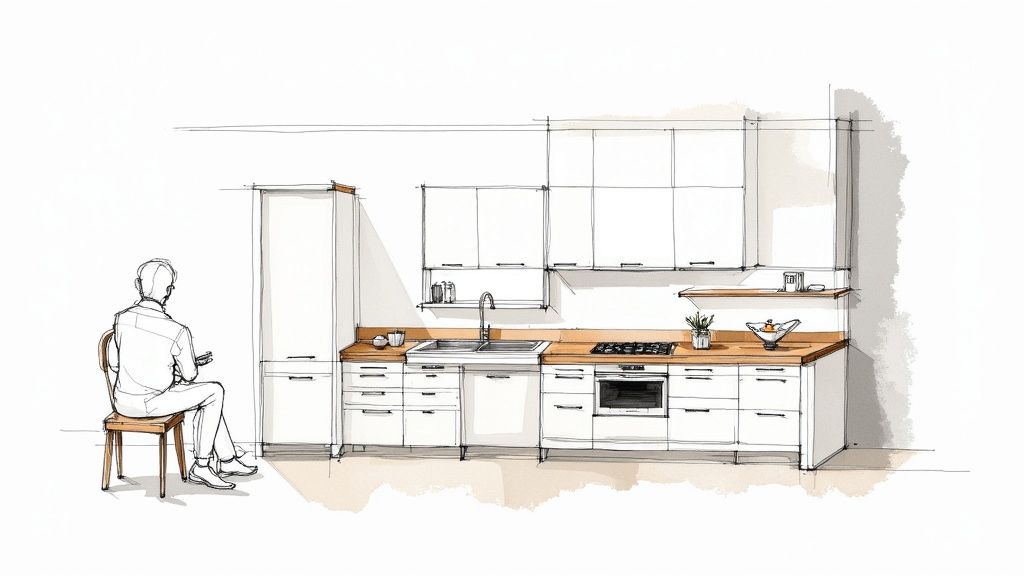
To achieve the contemporary Italian look, focus on creating an atmosphere of pure, effortless elegance where every detail feels intentional. Every cabinet, countertop, and appliance must work together in harmony.
Your goal is to craft an environment that elevates modern life. Your kitchen becomes a living, breathing space that fluidly hosts everything from lively family dinners to quiet morning coffees.
At its core, this design is guided by the Italian idea of la bella figura—making a beautiful impression. In the kitchen, this translates to a space that is impeccably organized, visually calm, and always put-together. To apply this, think of your kitchen like a bespoke suit: tailored, precise, and radiating quiet confidence. It doesn't need to shout for attention; its quality and perfect fit should be its most powerful statement.
Embracing Minimalism and Function
One of the cornerstones of this style is a deep commitment to minimalism, but one that never feels cold or sterile. Your aim isn't to create a laboratory. Achieve a warm, curated simplicity where every single item has a clear purpose and a designated place. You can bring in that warmth and character through incredible materials and subtle, touchable textures.
This focus on function means the kitchen should almost anticipate your next move. Integrate storage cleverly so it's hidden away, conceal appliances behind seamless panels, and engineer the entire layout for a natural, easy workflow. Your result should be a stunningly uncluttered space where the real focus can be on the joy of cooking and connecting with the people you love.
A contemporary Italian kitchen is a masterclass in 'sprezzatura'—a studied carelessness that makes a highly functional and meticulously planned space appear completely effortless and natural.
More Than Just a Room
Ultimately, when you embrace this style, you’re completely reimagining what a kitchen can be. It stops being a mere utility room and transforms into the central stage for your life. It’s a space that quietly speaks to a love for quality, intentional living, and the profound beauty found in simplicity.
This philosophy naturally extends beyond the kitchen, influencing the entire feel of your home. You can see how these same principles shape other living spaces in our guide to Italian contemporary interior design.
Now, let's dive into the practical steps. We'll explore the specific materials, color palettes, layouts, and lighting that will help you bring this incredible style into your own home. Get ready to create a kitchen that isn't just beautiful, but is a perfect reflection of a modern, elegant, and soulful way of living.
The Essential Elements of Italian Kitchens
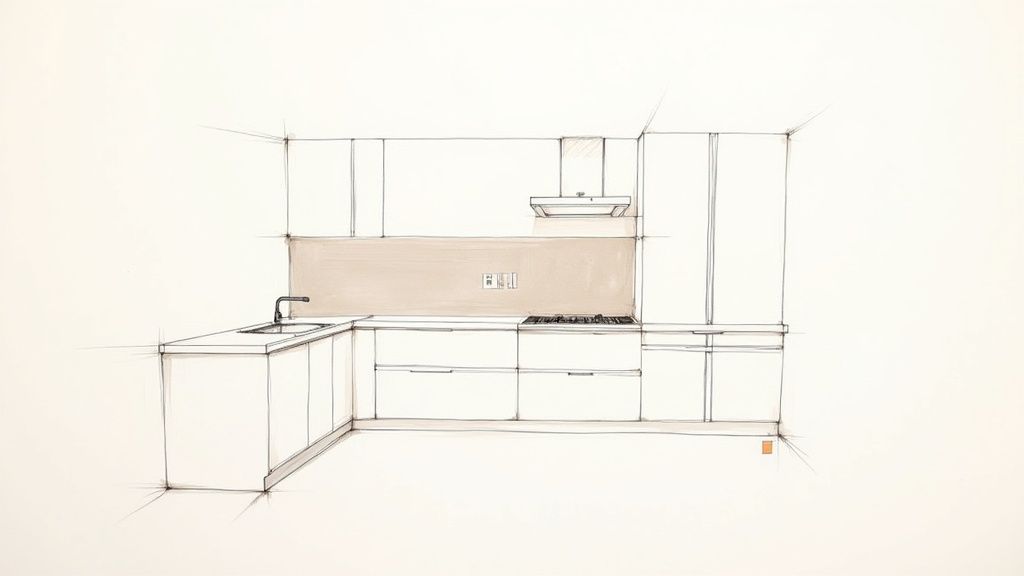
To execute contemporary Italian kitchen design, you must understand its fundamental building blocks. Master these core elements to create a space that feels both authentic and uniquely yours. Your starting point is a firm commitment to the philosophy of "less is more."
This idea is best expressed through the clean, unbroken lines that define these spaces. The ultimate goal is to create a sense of visual peace, where nothing unnecessary pulls at your attention. This is where your design choices make all the difference.
Crafting a Seamless and Uncluttered Canvas
Your first step is to quiet the visual noise. To do this, choose handleless cabinetry to create a single, uninterrupted surface that flows effortlessly. Signature features like push-to-open mechanisms or sleek, recessed channel pulls are key to maintaining this minimalist facade, making the cabinetry feel more like an architectural element than just a set of cupboards.
Apply the same rule to your appliances by integrating them fully behind custom panels. The refrigerator, the dishwasher, even the oven should all blend seamlessly into the cabinetry, forging a cohesive and unified look. This isn't just about hiding clutter; it's about curating a calm, intentional environment where the real stars are the form, the materials, and the people who gather there.
This passion for sleek, integrated solutions is a huge driver in the design world. The Italian modular kitchen market, currently valued at around USD 783.9 million, is expected to see major growth. This signals a powerful demand for these functional yet stunningly beautiful designs. Unsurprisingly, cabinets make up the largest segment, which just goes to show how central these seamless storage solutions are. You can explore more on this trend in this detailed market analysis.
A Symphony of Signature Materials
The true soul of a contemporary Italian kitchen is found in its materials. Every selection you make must be intentional, striking a perfect balance between timeless, natural beauty and incredible modern performance. This tactile layer is what elevates a kitchen from merely minimalist to something genuinely warm, luxurious, and inviting.
Natural stone will always be a cornerstone. Select materials like classic Carrara marble or a dramatic slab of quartzite to bring a touch of organic artistry to countertops and backsplashes. At the same time, don't be afraid to embrace new technologies, a hallmark of celebrated Italian design.
The genius of Italian design lies in its ability to honor tradition while fearlessly innovating. It pairs ancient marble with modern composites in a way that feels both timeless and completely of the moment.
This forward-thinking spirit paves the way for advanced materials that offer superior durability and unique finishes. For example, you could choose:
- Fenix NTM: An incredible, innovative material known for its super-matte, anti-fingerprint surface. It’s soft to the touch yet unbelievably resilient.
- Engineered Quartz (Silestone): Gives you the stunning look of natural stone without the high maintenance. It provides a consistent, non-porous surface that’s perfect for the demands of a busy kitchen.
- Laminates: Today's high-pressure laminates (HPL) have come so far. They offer a huge range of finishes, from hyper-realistic wood grains to bold solid colors, giving you incredible design flexibility and robust performance.
Choosing the right materials is about creating a dialogue between texture and form. The following table breaks down some of the most popular choices, helping you weigh their aesthetic and practical qualities.
Key Materials in Contemporary Italian Kitchens
| Material | Key Characteristics | Best For | Maintenance Level |
|---|---|---|---|
| Natural Stone (Marble, Quartzite) | Unique veining, organic beauty, porous, can be prone to staining or etching. | Statement islands, backsplashes, and luxury countertops. | High |
| Engineered Quartz | Non-porous, highly durable, consistent color and pattern, scratch-resistant. | High-traffic countertops, family kitchens, and seamless surfaces. | Low |
| Fenix NTM® | Super-matte, anti-fingerprint, soft-touch finish, thermally-reparable micro-scratches. | Cabinet fronts, countertops, and tabletops for a modern, tactile feel. | Low |
| High-Pressure Laminate (HPL) | Versatile finishes (wood, metal, solid), cost-effective, durable and easy to clean. | Cabinetry, worktops, and vertical surfaces where flexibility is key. | Very Low |
| Solid Wood | Warmth, natural grain, adds texture and a connection to nature. | Accent features, open shelving, or butcher-block islands. | Medium to High |
Ultimately, your goal is to create a rich, tactile experience that is as beautiful to touch as it is to behold.
Building a Sophisticated Color Palette
In a contemporary Italian kitchen, use color with restraint and purpose. Your palettes should be refined and sophisticated, designed to create a serene backdrop rather than an overwhelming visual statement. How you approach color will define the entire mood of your kitchen.
Start by building your design on a strong neutral foundation. Use soft shades of white, warm greys, inviting taupes, and deep, grounding charcoals. These colors create an immediate sense of spaciousness and light, allowing the quality of your materials to shine.
From this neutral base, you can take one of two paths:
- Monochromatic Harmony: Use a single color family in a variety of tones and textures to create a subtle, layered effect. A kitchen designed in multiple shades of grey, for instance, feels incredibly cohesive, calm, and effortlessly chic.
- Bold, Artistic Accents: Use your neutral canvas and punctuate it with a single, confident splash of color. This could be a dramatic island in a deep jewel tone, a vibrant backsplash that catches the eye, or a statement piece of furniture that serves as the room’s focal point.
By mastering these foundational elements—the seamless surfaces, the premium materials, and the intentional color palettes— you’re well on your way to building a contemporary Italian kitchen. It becomes more than just a place to cook; it becomes a testament to enduring style and a more thoughtful way of living.
Designing Your Kitchen Layout for Perfect Flow
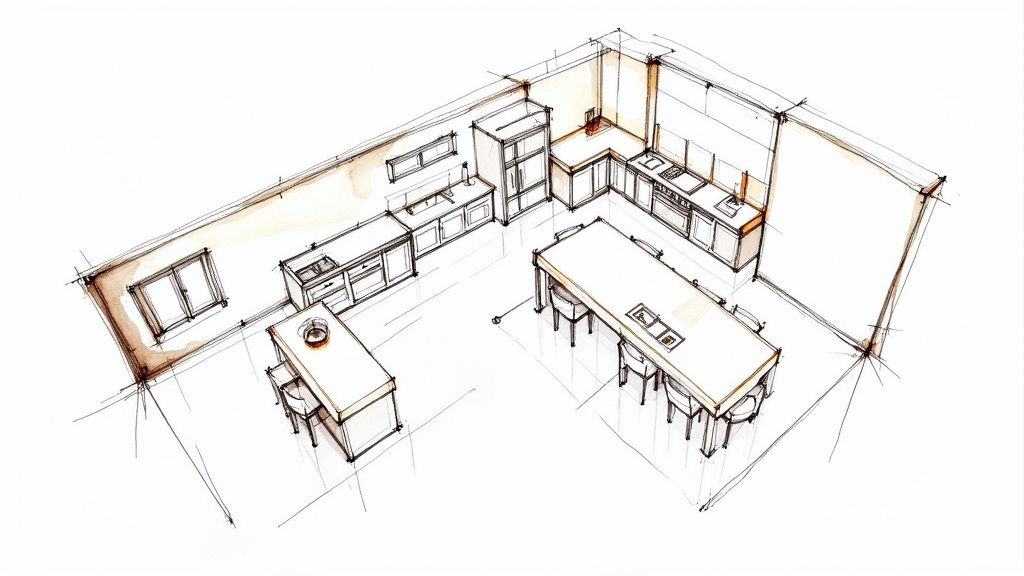
A contemporary Italian kitchen is built for living. It’s an environment engineered for an effortless, intuitive experience. The layout isn't just about where you place the cabinets—it’s about creating an efficient flow. To achieve this, you must design your kitchen using smart "zoning."
Instead of seeing your kitchen as one big room, plan it as a collection of interconnected, high-performance zones. Each one should have a clear purpose—prepping, cooking, cleaning, and socializing. A successful layout ensures you can move between them without wasted steps, turning the space into a natural extension of your movements.
Mastering the Art of Kitchen Zoning
To begin, walk through your daily routine in your mind. Where will you chop vegetables? Where will you plate a meal? Where will friends gather while you cook? By defining these essential activities, you can start to build a layout that supports them perfectly.
The goal is to establish a functional "work triangle"—or, for modern spaces, a series of efficient "workstations." This principle ensures that the refrigerator, sink, and cooktop are arranged logically to cut down on travel time and effort.
-
The Prep Zone: This space works best when placed between the refrigerator and the sink. Ensure you have plenty of clear counter space for chopping and mixing, with knives, cutting boards, and a waste bin all within arm's reach.
-
The Cooking Zone: Center this area around the cooktop and oven. Plan storage for pots, pans, spices, and oils nearby. It is essential to have heat-resistant counter space on either side for resting hot dishes.
-
The Cleaning Zone: Anchor this zone with the sink and dishwasher, and integrate bins for trash and recycling. Store dishes, cutlery, and cleaning supplies nearby to make unloading the dishwasher efficient.
This thoughtful organization is what contemporary Italian design is all about. It’s about crafting an uncluttered workflow that feels completely instinctual. To get your inspiration flowing, you might want to explore some of these timeless kitchen layout design ideas.
Adapting Italian Principles to Your Space
The beauty of this zonal approach is how wonderfully it adapts. Whether you're working with a large open-concept room or a small galley kitchen, the core ideas hold true. It all comes down to using smart design to maximize your specific layout.
For Open-Concept Kitchens:
Make the island the hero of the space. Design it to wear multiple hats: one side dedicated to prepping and cooking, the other inviting guests to pull up a barstool. This creates a graceful boundary that keeps friends engaged but safely out of the main work area, maintaining a seamless flow for the cook.
For Galley or L-Shaped Kitchens:
In these more compact layouts, efficiency is everything. Maximize vertical space and use clever integrated solutions. Specify tall pantry units with pull-out shelving to store more, and place appliances strategically to create a clear, linear path from one task to the next.
A truly well-designed Italian kitchen doesn't just look good—it feels good. It anticipates your needs, placing everything you require exactly where you expect it to be, making the act of cooking a pleasure rather than a chore.
The Power of Integrated Storage
Finally, you can't achieve perfect flow without brilliant storage. In Italian design, this means hiding functionality in plain sight. Opt for deep drawers with custom dividers over standard cabinets, as they provide a better view and easier access to everything inside.
Specify concealed solutions. Use appliance garages to keep toasters and coffee makers out of sight, corner cabinets with rotating carousels that use every last inch, and discreet charging stations tucked away inside a drawer. This dedication to hidden functionality is what preserves the clean, minimalist aesthetic while delivering a space that is profoundly practical and always ready for action.
Integrating Appliances for Seamless Performance
In a contemporary Italian kitchen, appliances are not afterthoughts; they are integral parts of the design. The goal is to create a calm, unbroken line, where state-of-the-art technology is felt but not necessarily seen. Your appliances should support the art of cooking without shouting for attention.
To achieve this, weave technology right into your cabinetry. Dishwashers, refrigerators, and even ovens should disappear behind custom panels that perfectly match the cabinets they sit beside. This is how you achieve the clean, minimalist vistas that define Italian style.
Choosing Your Culinary Partners
Finding the right appliances is crucial for striking that perfect chord between beauty and performance. Iconic Italian brands like Smeg and Bertazzoni are masters of this, designing machines that are beautiful enough to stand on their own.
However, the Italian design philosophy is about a passion for quality, no matter the origin. You'll often see German engineering from brands like Miele and Bosch, celebrated for their reliability and smart features. Their panel-ready models are designed to integrate perfectly. The question to ask yourself is: do you want a subtle design accent, or complete visual silence?
True integration is when you can run your hand along a wall of cabinets and not feel the transition from wood to metal. It’s a quiet testament to incredible precision and a deep appreciation for visual calm.
The Rise of Smart and Efficient Technology
A modern Italian kitchen isn't just beautiful—it's smart. There is a huge shift toward connected, energy-efficient appliances that make life easier. The Italian kitchen appliance market is growing, with projections showing steady expansion through 2030, largely driven by the demand for smarter homes. Appliances you can control from an app are becoming the new standard.
This infusion of smart tech opens up practical possibilities:
- Integrated Coffee Systems: Install a plumbed-in espresso machine that sits flush with your cabinetry, ready to deliver a perfect caffè at the touch of a button.
- Smart Ovens: Preheat your oven from your phone on your way home, so your kitchen is ready the moment you walk through the door.
- Induction Cooktops: Choose these for a sleek, powerful, and easy-to-clean surface. Their completely flat profile is a minimalist’s dream, offering precise heat in an instant.
Practical Tips for Perfect Integration
Achieving a seamless look requires foresight and planning. This needs to be one of the very first conversations you have with your designer.
The first rule: choose your appliances before finalizing your cabinet plans. Your cabinet maker needs the exact spec sheets to build a perfectly snug, custom home for each appliance, leaving no unsightly gaps.
Second, think about how you move in the kitchen. Sometimes, achieving an effortless feel means choosing compact kitchen appliances for small spaces that offer big performance. Integrated refrigerator drawers, for instance, are a brilliant way to add cold storage to an island or a small galley kitchen without breaking up the visual flow.
By selecting appliances that respect both performance and design, you create a space that feels effortlessly capable. It becomes your high-tech culinary command center, beautifully disguised as a serene and stylish retreat.
Using Strategic Lighting to Shape Your Space
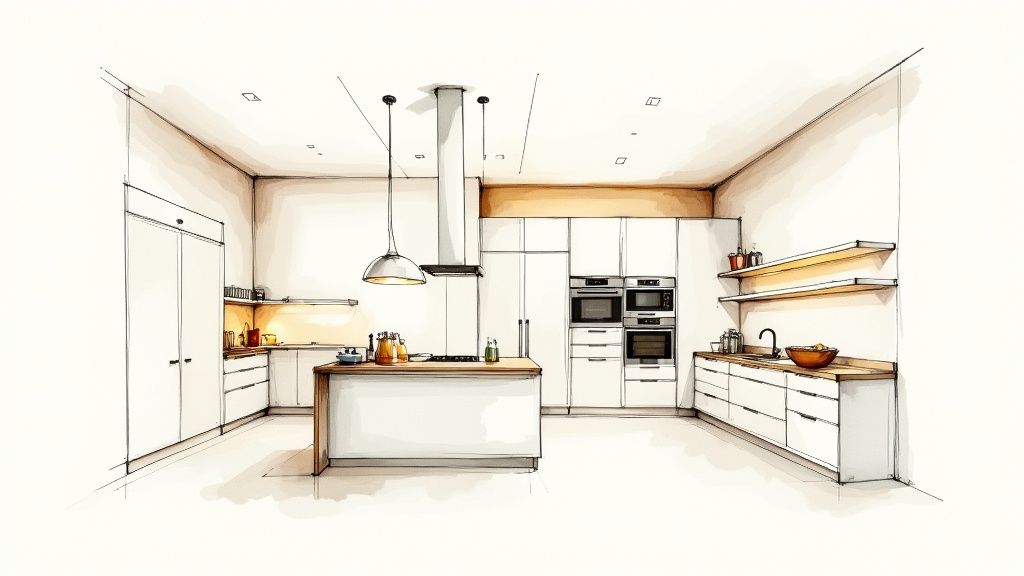
Lighting is the secret ingredient that truly brings a contemporary Italian kitchen to life. It is a powerful design tool that sculpts the atmosphere, highlights material textures, and catches the gleam on polished surfaces. Treat lighting as a core part of the design from day one by planning a multi-layered strategy that marries function with feeling.
Instead of a single, harsh overhead light, embrace a trio of lighting layers that work together. This approach will turn your kitchen into both a brilliant workshop and an intimate social hub.
The Three Essential Layers of Light
To get the perfect balance, you must implement three distinct types of lighting. Each one has a specific job, and when combined, the result is a rich, dynamic, and versatile environment.
-
Ambient Lighting: This is your foundation—the general, even illumination that fills the room. Achieve this with discreet recessed pot lights or a series of minimalist pendants that cast a wide, welcoming light over the entire space.
-
Task Lighting: This is your workhorse. It must be bright, focused, and aimed right where you need it for safety and precision. The best way to achieve this is with under-cabinet LED strips that throw a clear, shadow-free light directly onto your prep surfaces.
-
Accent Lighting: This is where you add drama and personality. Use accent lights to draw the eye to special features—a textured backsplash, a piece of art, or curated objects on open shelving. It’s the finishing touch that makes the space feel truly yours.
Good lighting design makes you feel good. It can energize you for the day's tasks and then help you unwind in the evening, all with the simple flick of a switch or the slide of a dimmer.
Selecting Fixtures with Italian Sensibility
The light fixtures you choose are just as important as the light they cast. To stay true to the minimalist aesthetic, select fixtures that are clean-lined, sculptural, and intentional. They should complement the design, not overpower it.
A dramatic, sculptural pendant hanging over a kitchen island can act as a stunning focal point. Sleek, linear suspension lights offer a more understated but equally powerful statement, especially over a long countertop or dining table. For a closer look at finding the perfect fixtures, you can explore more about exceptional lighting from Italy and see how these pieces can elevate any room.
Creating Mood with Dimmers and Smart Systems
The final piece of the lighting puzzle is control. You must install dimmers on every light source. This simple addition gives you the power to instantly shift the kitchen's mood.
Set the task lights to 100% for focused meal prep, then dim the ambient pendants to a warm, low glow for a relaxed dinner party. Smart home systems take this a step further, letting you create and save custom lighting "scenes" for different activities—like 'Cooking,' 'Entertaining,' or 'Relaxing'—all with a tap on your phone or a voice command. This level of control is what turns a beautiful kitchen into a truly responsive and intuitive living space.
Bringing It All Together with Intentional Style
The final layer that breathes life into a contemporary Italian kitchen is a concept called sprezzatura. It's the art of making something that's been carefully considered look completely effortless. This is where you move beyond the blueprint and start infusing the space with soul by adding finishing touches with a curator's eye.
To do this, make every object earn its place. Treat your countertops not as storage, but as a gallery stage. Instead of cramming them with gadgets, intentionally select a few beautiful, functional pieces that deserve the spotlight. It's not about decorating for the sake of it; it's about choosing objects that are as stunning to look at as they are useful.
Curating Functional Beauty
The secret lies in choosing everyday items that are works of art. This keeps the kitchen feeling minimalist while adding an essential layer of warmth and personality. Every piece should feel like it has a story or a specific purpose.
Here are actionable ways to blend utility and style:
- Designer Appliances: Place a sleek, architectural espresso machine on your counter. It's not just for coffee; it's a functional sculpture.
- Artisanal Ingredients: Display a beautiful bottle of cold-pressed olive oil in an elegant glass vessel or a rustic block of sea salt to add an authentic, culinary touch.
- High-Quality Cookware: Lean a gleaming copper pot or a substantial wooden cutting board against the backsplash to introduce texture and warmth.
This deliberate curation speaks to a deep appreciation for craftsmanship. You see this reflected in the Italian kitchenware market itself, which brilliantly blends culinary tradition with design innovation. It's a market valued at nearly USD 1,980 million and growing, fueled by a collective return to home cooking and a desire for tools that perform beautifully. You can dive deeper into these trends in this in-depth market report on Grand View Research.
The Power of a Single Focal Point
In a room built on clean lines, a single, powerful focal point makes an incredible impact. This is your chance to make a bold statement without creating visual noise. Create one moment of interest that immediately draws the eye and anchors the entire space.
For example, place a single, sculptural vase from Griseo Interior on the corner of an island. Its soft, organic form creates a stunning contrast to the kitchen's sharp, linear geometry. With its minimalist shape and artisanal feel, it becomes a piece of art that doesn't need flowers to make a statement.
Likewise, a thoughtfully chosen piece of furniture can complete the picture. If your kitchen flows into a dining space, your choice of seating is crucial. To find pieces that echo the kitchen's design philosophy, explore our guide on selecting the perfect Italian dining chairs. Even one masterfully crafted chair or stool can act as a functional accent that ties the whole look together.
"True Italian style is not about what you add, but what you can no longer take away. Each object must earn its place through its beauty and its utility."
By embracing sprezzatura, you learn to edit your space with confidence. Every item, from your coffee machine to a simple vase, should add to the kitchen’s quiet, self-assured elegance. This is how you transform a well-designed room into a space that feels personal, loved, and effortlessly chic.
Your Italian Kitchen Questions, Answered
Stepping into the world of contemporary Italian kitchen design can feel intimidating, but it doesn't have to be. Here are actionable answers to common questions, so you can feel confident and inspired.
How Can I Get the Italian Kitchen Look on a Smaller Budget?
You can achieve this look with smart choices rather than a massive budget. It’s all about where you focus your spending.
Start by prioritizing high-quality laminate or composite countertops that replicate the look of natural stone. Then, source flat-panel, handleless cabinet doors from well-known suppliers; this is the quickest way to capture the essential seamless aesthetic. With those basics in place, you can invest in one or two signature pieces where quality really counts—a striking designer faucet or a pair of minimalist pendant lights that elevate the whole space.
Remember, the most effective tools for creating a luxurious feel are often free. A simple, neutral color palette and a fierce dedication to keeping things decluttered will instantly elevate your space, giving it that unmistakable sense of calm and sophistication.
Is Contemporary Italian Design Practical for a Family Home?
Absolutely. In fact, it's one of the most family-friendly styles. The core principles—high-performance materials, durable surfaces, and smart, ergonomic layouts—are exactly what a busy family needs.
Seamless, easy-to-clean surfaces are a lifesaver for spills and messes. Clever storage solutions mean there’s a home for everything, keeping clutter under control. Many innovative materials used, like Fenix, are anti-fingerprint and scratch-resistant. On top of that, the open-plan layouts common in this style naturally bring everyone together, making the kitchen the true heart of the home for cooking, homework, and family time.
What Is the Difference Between Modern and Contemporary Italian Design?
People often use these words interchangeably, but there's a key difference. Modern design refers to a specific historical movement from the mid-20th century. It has a defined aesthetic characterized by natural woods and strong, angular forms.
Contemporary design, however, is about the now. It is a living style that is constantly evolving. It borrows the clean lines and minimalist spirit from modernism but layers in brand-new materials, advanced technology like integrated smart appliances, and a softer, more luxurious take on simplicity. Think of it this way: modern design is a photograph from a specific era, while contemporary design is a film that's still being made.
Ready to place that final, artful touch in your kitchen? The minimalist vases and sculptural accents from Griseo Interior are designed to be the perfect focal point, embodying the effortless elegance of true Italian design. Explore the Griseo Interior collection to find the piece that will complete your vision.