

How to arrange furniture in living room for ideal flow and comfort
Before pushing a single piece of furniture, start with a plan. Measure your space, determine its main purpose, and sketch a basic layout. This initial step is the key to avoiding common problems like blocked pathways or an awkward flow. A few minutes of prep work will ensure your final design is both functional and beautiful.
Create Your Living Room Blueprint
A good blueprint turns the overwhelming task of arranging furniture into a manageable, creative process. It saves you the time and physical effort of moving heavy items multiple times. Planning is the first step in any comprehensive living room makeover ideas, whether you're starting from scratch or just refreshing your space.
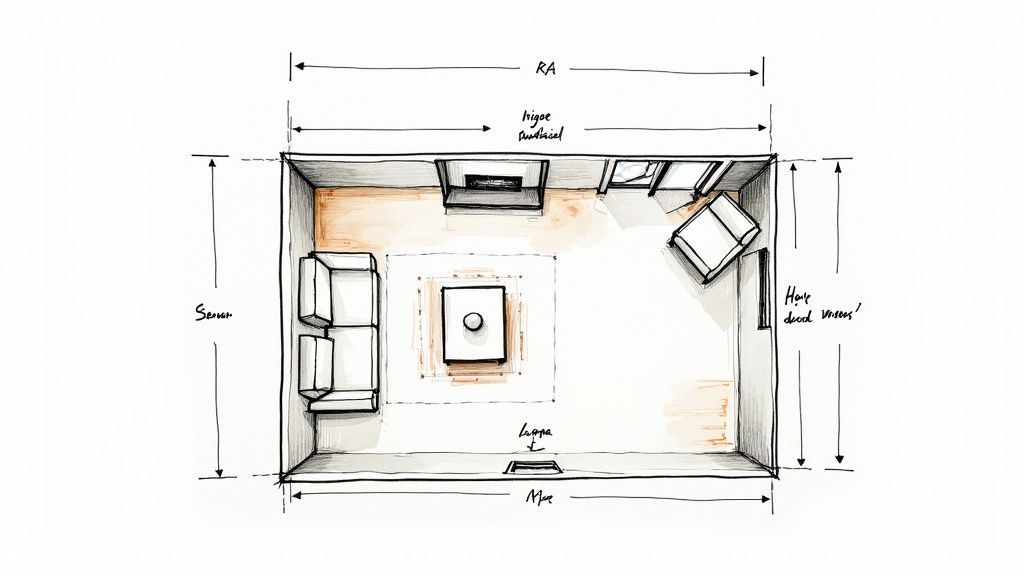
Treat this stage like gathering data. You're mapping out the room's fixed elements and dimensions to create a living space that not only looks good but also works for your daily life.
Start with Measurements and a Sketch
Grab a tape measure, paper, and a pencil. You don't need special software to create a functional floor plan. First, measure the length and width of the room, noting the dimensions of each wall.
Next, add the fixed features you must work around. These are the non-negotiables of your layout.
- Doors and Windows: Note their width and location, and indicate which way doors swing open.
- Fireplaces or Built-ins: Measure their dimensions and mark their exact position on your sketch.
- Outlets and Vents: Mark these on your plan so you don't block power sources or obstruct airflow.
Once the room is mapped, measure your main furniture: the sofa, armchairs, coffee table, and any other large items like a media console. Having these dimensions ready allows you to experiment with different arrangements on paper first.
Pro Tip: Use painter's tape to outline the footprint of your furniture directly on the floor. This gives you a real-world sense of the scale and flow before you move anything heavy.
Define Your Living Room's Primary Role
Now, ask yourself: what is the primary function of this room? Your answer will guide every layout decision you make.
Decide on the room's main purpose:
- A Cozy Media Hub? If the room is for watching movies, prioritize comfortable seating with a clear, glare-free view of the screen.
- A Formal Entertaining Space? For hosting guests, arrange seating to encourage conversation. This usually means placing chairs and sofas so they face each other.
- A Versatile Family Zone? If the room serves multiple purposes like relaxing, playing, and working, plan distinct zones for each activity.
Defining the room's role ensures your layout is intentional and supports your lifestyle, preventing the common mistake of having a beautiful room that doesn't function well.
Find and Emphasize Your Focal Point
A successful living room layout always has a strong focal point. This is the room’s anchor—the first thing that draws your eye and gives the space a sense of purpose. Without a focal point, furniture can look like it's floating aimlessly.
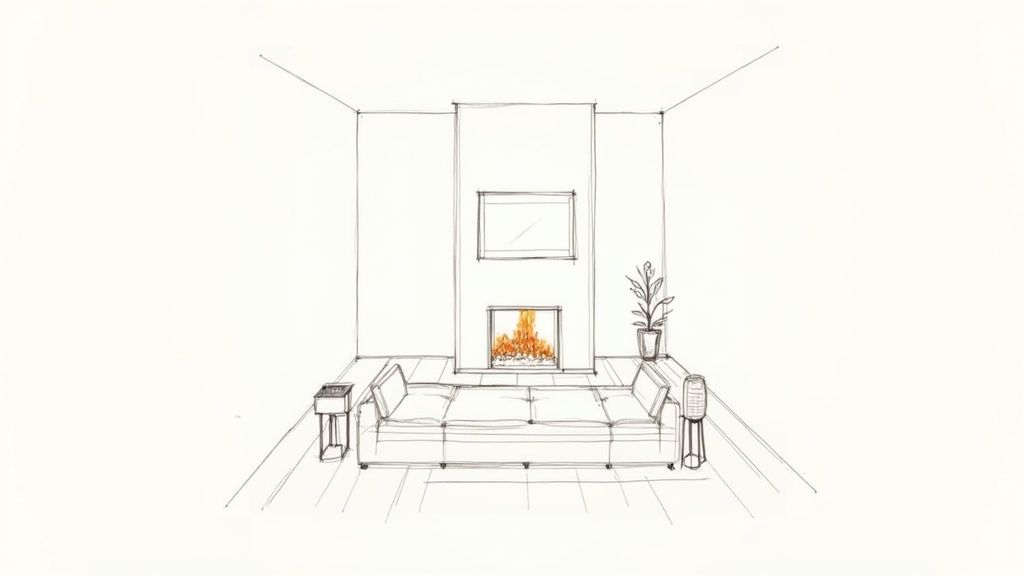
Your room's architecture often provides a natural focal point, such as a fireplace or a large picture window. These features are natural attention-grabbers, and your furniture arrangement should highlight them.
What If You Don't Have an Obvious Focal Point?
If your room is a simple box without a built-in feature, you can create your own. This gives you complete control over the room's feel.
Establish a focal point by using one of these elements:
- A Media Center: For many homes, the television is the central gathering spot. A well-designed media unit can serve as a strong, functional anchor.
- A Statement Piece of Art: A large painting or a gallery wall instantly becomes the room's main attraction and injects personality.
- A Bold Accent Wall: Painting one wall a dramatic color or applying patterned wallpaper creates a powerful visual anchor for a relatively low cost.
The key is to choose one dominant feature. Multiple competing focal points—like a fireplace, a TV, and a large artwork all on different walls—can make a room feel chaotic. If you have both a fireplace and a TV, either decide which one is primary or place them on the same wall to create a single visual unit.
If you need ideas, our guide to finding unique statement pieces for your living room can help.
A strong focal point acts as a compass for your furniture. Once you've identified it, all other placement decisions become easier and more logical.
Arranging Furniture Around Your Anchor
Once you've selected your focal point, arranging the furniture becomes straightforward. Start with your largest seating piece, which is usually the sofa. Position it so it directly faces or has a clear view of the focal point.
For example, if the fireplace is your focal point, the sofa should face it to encourage cozy gatherings. If it's the TV, the same principle applies for optimal viewing.
By aligning your main furniture with this central feature, you establish balance and order. From there, arrange smaller items like armchairs, a coffee table, and side tables in relation to the sofa to complete the layout.
Explore Popular Furniture Layouts
With your focal point chosen, it's time to arrange your seating. The goal is to create a layout that encourages conversation, provides comfort, and suits the room's function.
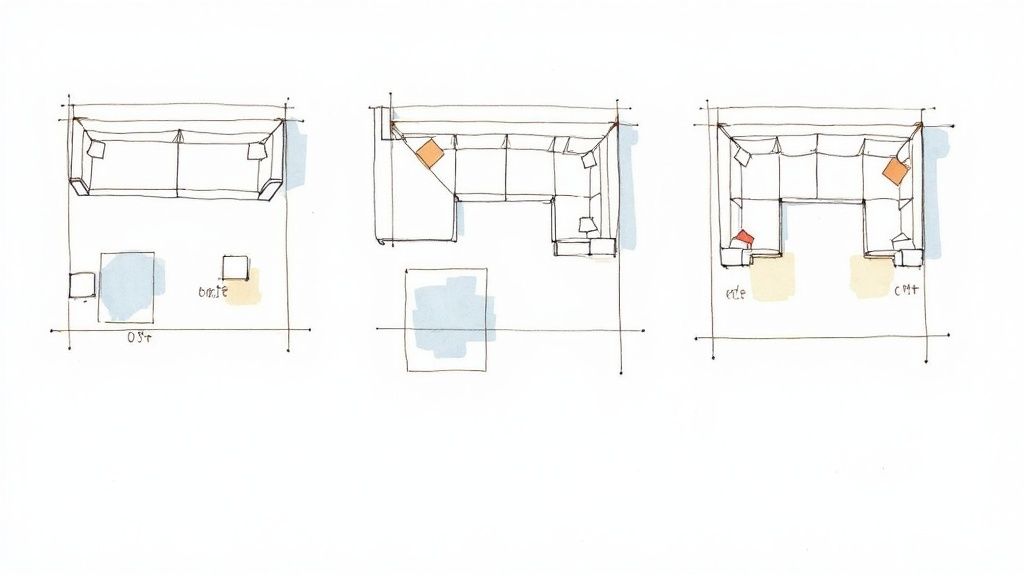
You don't need to invent a layout from scratch. Designers rely on several classic arrangements that are proven to work. Use these as a starting point to find the best fit for your space.
The Symmetrical Face-To-Face Layout
This arrangement is ideal for formal living rooms or any space where conversation is the primary activity. It creates a sense of order, elegance, and balance.
To create it, place two sofas (or a sofa and two chairs) directly facing each other. This carves out a central pathway that often aligns with a focal point like a fireplace. A coffee table sits in the middle, anchoring the grouping.
This layout works well for:
- Long, narrow rooms, as it balances the width.
- Entertaining spaces, because the setup naturally encourages guests to interact.
- Classic or traditional decor styles, where symmetry is a key design principle.
The L-Shaped Configuration
The L-shape is a versatile and popular choice for modern, family-focused spaces and open-concept homes. Create this layout with a sofa and a loveseat (or two chairs) placed at a right angle, or by using a sectional sofa.
This arrangement effectively defines a cozy corner within a larger room. It's equally well-suited for watching movies and casual entertaining. It also keeps one side of the room open, which helps maintain clear traffic flow.
An L-shaped layout is a great solution when you need to accommodate both a television and a fireplace. Position the sectional to face both, creating a single, multifunctional zone.
The Conversational U-Shape
If you have a large living room and enjoy hosting, the U-shaped layout creates an intimate and inclusive seating area. This setup typically uses a sofa as the base, with chairs or loveseats on either side to form three sides of a square.
The furniture wraps around a central coffee table, drawing everyone into a comfortable circle. It's highly effective for fostering connection, making it ideal for game nights and large gatherings. For more ideas, you can find many expert tips on arranging living room furniture from professional designers.
The Beauty Of A Floating Layout
One of the most effective ways to make a room feel more polished is to pull your furniture away from the walls. This "floating" layout makes a space feel more intentional and airy. Even moving a sofa just a few inches off the wall creates breathing room.
In large rooms, floating the entire seating arrangement in the center defines an intimate conversation zone. This technique is particularly useful in open-plan spaces, where it can visually separate the living area from a dining or kitchen zone without walls.
To complete this look, place a console table behind the floating sofa. It adds a finished touch and provides a surface for lighting and decor.
To help you decide, here's a quick breakdown of these common approaches.
Common Living Room Layouts at a Glance
A quick comparison of popular furniture arrangements to help you choose the best fit for your space and needs.
| Layout Type | Best For | Key Characteristic | Pro Tip |
|---|---|---|---|
| Symmetrical | Formal rooms, conversation | Two sofas/chairs face each other, creating balance | Use matching seating pieces to enhance the symmetrical feel. |
| L-Shaped | Family rooms, open-concept spaces | Seating forms a right angle, defining a corner | Great for sectionals; it naturally directs focus to a TV or fireplace. |
| U-Shaped | Large rooms, entertaining | Three-sided arrangement that fosters intimacy | Ensure there's enough room to walk around the perimeter comfortably. |
| Floating | Large or open-plan rooms | All furniture is pulled away from the walls | Place a slim console table behind the sofa for added style and function. |
Choosing the right layout is about more than just placing furniture—it’s about designing the experience you want to have in your living room. It’s about creating a space that invites you to relax, connect, and live well.
Mastering Space and Traffic Flow: The Secret to a Room That Just Works
A well-arranged living room feels effortless to move through. This is the result of proper spacing and clear traffic flow, and achieving it is simpler than you might think.
By following a few key measurements, you can ensure your room is designed for comfortable, everyday living.
These numbers are not rigid rules but proven guidelines that help make a layout feel comfortable and intuitive.
Creating Clear Pathways for Effortless Movement
The foundation of a functional layout is good traffic flow. You should be able to walk through your living room without bumping into furniture. The goal is to establish clear, unobstructed paths from one doorway to another.
For main pathways—the routes you use to enter, exit, or cross the room—aim for a width of 30 to 36 inches. This prevents the space from feeling cramped. For smaller, secondary paths within a seating area, a minimum of 18 to 24 inches is sufficient.
A room that is easy to navigate is a room you'll enjoy using. Before finalizing your layout, walk the main paths. If you have to turn sideways or weave around furniture, the arrangement needs adjustment.
Getting the Spacing Just Right Between Pieces
Beyond the main walkways, the space between your furniture pieces is crucial for creating a connected and usable seating area. These measurements ensure everything is within reach without feeling crowded.
Here are the most critical distances to remember:
- Sofa to Coffee Table: Leave 14 to 18 inches between the edge of your coffee table and the front of your sofa. This is close enough to place a drink but provides enough legroom.
- Seating Arrangement: To encourage conversation, place seating no more than 8 to 10 feet apart. This ensures no one has to shout to be heard.
- Side Table Proximity: A side table should be easily reachable. Position it just 2 to 3 inches from the arm of a sofa or chair.
Understanding the Art of Scale and Proportion
The size of your furniture relative to your room and to other pieces is critical. A huge sofa in a small room will feel overwhelming because the scale is wrong. Similarly, furniture pieces should be in proportion to one another.
A helpful guideline is for your main sofa to take up roughly two-thirds of the wall it sits against. This maintains visual balance. Your coffee table should be about two-thirds the length of your sofa, and its height should be within a few inches of your sofa's seat height.
Avoid common scale mistakes. For example, an area rug that's too small will make your entire room feel disconnected. As a rule, make sure at least the front legs of all your main seating pieces rest on the rug. This anchors the arrangement and makes the space feel larger and more cohesive. Getting these details right is how you arrange furniture in a living room like a professional.
Layering in the Magic: Rugs, Lighting, and Decor
With the main furniture in place, the next step is to add the layers that bring your room to life. Rugs, lighting, and decor transform a well-arranged space into a warm, inviting home with personality.
These final elements are what infuse your layout with character and comfort.
Start with the Foundation: Your Area Rug
An area rug defines and unifies your seating arrangement. It is one of the most powerful design tools available, but a common mistake is choosing a rug that is too small. A small rug floating in the middle of the floor can make the entire room feel smaller and disjointed.
Your goal is to choose a rug size that connects the entire furniture group into one cohesive unit.
My Golden Rule for Rugs: The rug must be large enough for at least the front legs of your sofa and all accent chairs to rest on it. This single action visually connects all the pieces, creating a defined zone.
Follow these spacing guidelines:
- In a larger room, leave about 24 inches of bare floor between the rug's edge and the walls.
- For smaller spaces, a gap of 10 to 18 inches works well and helps the room feel more open.
When in doubt, choose the larger rug. A generously sized rug almost always makes a room feel more expansive and luxurious, giving your furniture arrangement a deliberate, high-end look.
The demand for beautiful, functional spaces is a key factor in the global living room furniture market. Homes need to reflect modern life, where every piece serves both an aesthetic and a practical purpose. You can see more about these trends in the living room furniture market and how they influence design.
Let There Be Light: An Illuminating Plan
Good lighting is essential. It sets the mood, supports activities like reading, and highlights your carefully arranged furniture. A successful lighting plan uses multiple light sources layered at different heights.
Do not rely on a single overhead light. Instead, create a balanced mix:
- Ambient Light: This is the room's overall illumination, typically from a ceiling fixture or recessed lighting. It provides the base layer of light.
- Task Light: This is focused light for specific activities. Examples include a floor lamp next to a reading chair or a table lamp on a console.
- Accent Light: Use this to highlight artwork, architectural details, or plants. Wall sconces or a small uplight can add drama and a high-end feel.
The goal is to create warm, inviting pools of light that give the room dimension. When placing a floor or table lamp, ensure the bottom of the shade is roughly at eye level when you are seated. This prevents harsh glare and casts a soft, flattering light.
The Final Flourish: Decor and Side Tables
Now add the personal touches that make the space yours. Side tables and decor provide both function and style. Every seat should have a convenient surface nearby for a drink or a book.
For easy access, choose a side table that is within a few inches of the sofa or chair's arm height. The side table's depth should not exceed the depth of the sofa it's next to. Mix materials and shapes for a curated look—a round metal table can provide a nice contrast to a square, upholstered sofa.
Finally, style your surfaces. A stack of books on the coffee table, a sculptural Griseo Interior vase on a console, and a touch of greenery add color, life, and texture. These are the details that give your living room soul, turning a well-arranged space into a place that truly feels like home.
Tackling Those Tricky Layouts
Not every living room is a simple rectangle. Many spaces present unique challenges, such as a small footprint, an open-concept design, or awkward angles. Treat these challenges as opportunities to get creative.
Modern design embraces flexibility and real-world function over stuffy formality. You can see how modern lifestyles are shaping furniture trends and changing how we approach our homes.
Making a Small Living Room Feel Grand
In a small space, every furniture choice matters. The goal is to maximize the sense of openness and avoid a cluttered feel.
- Go for Leggy Furniture: Choose sofas, chairs, and tables with visible legs. Lifting furniture off the floor allows you to see more of the floor, which makes a room feel larger and more airy.
- Think Vertically: Draw the eye upward. Use tall, slender bookcases or hang curtains high and wide to emphasize the room's height, distracting from its small footprint.
- Lean on Mirrors: Place a large mirror on a wall to bounce light around the room and create an illusion of depth.
For a deeper dive, our guide on small living room design ideas is packed with more tips for maximizing your space.
Taming the Great Wide Open
An open-concept room can feel vast and undefined. The key is to create distinct, functional "zones" for different activities.
Use large area rugs to anchor each zone—one for the main seating area, and perhaps another for a reading nook or play area. Furniture can also act as a visual divider. Float a sofa in the middle of the space with a console table behind it to create a soft boundary between the living and dining areas without using walls.
In an open-plan layout, use a consistent color palette and repeat materials or textures throughout the space. This ensures that while the zones are separate, they feel like part of a cohesive whole.
Conquering the Awkwardly Shaped Room
For rooms with slanted walls, multiple doorways, or an off-center fireplace, work with the quirks instead of against them. An unusual angle can be the perfect spot for an accent chair and side table, turning an awkward corner into a cozy feature.
If you have too many doors, map out a primary traffic path that doesn't disturb the main seating area. To reduce visual clutter, paint the doors the same color as the walls to help them blend in. When you learn how to arrange furniture in a room that’s less than perfect, you unlock its true character.
Got Questions? We’ve Got Answers.
Arranging a living room can bring up specific questions. Here are answers to some of the most common challenges.
What If I Have More Than One Focal Point?
This is a common issue, like having a fireplace on one wall and a beautiful window on another. The solution is to not treat them equally.
Choose one as your primary focal point and arrange your main seating group to face it. Then, acknowledge the secondary feature with a smaller furniture grouping. For example, place a pair of armchairs and a small table by the window to create a reading nook that doesn’t compete with the main conversation area.
Where On Earth Do I Start in an Empty Room?
A blank slate can be intimidating. The key is to start with your largest and most important piece of furniture: the sofa.
Place your sofa first. It will act as the anchor for the entire room. Once it's positioned (usually facing the primary focal point), all other decisions become simpler. The armchairs, side tables, and rug can then be arranged in relation to it.
Placing your sofa is like making the first brushstroke on a canvas. It sets the direction for the rest of the room and makes the process feel more intuitive.
Is It Okay for Furniture to Touch the Walls?
Pushing all furniture against the walls is a common instinct, but it can make a room feel smaller and less inviting.
Unless your room is very small, pull your furniture away from the walls by at least a few inches. This creates breathing room and makes the layout feel more intentional. In a larger room, you can "float" the entire seating arrangement in the middle of the space for a more sophisticated look.
Ready to put the finishing touches on your masterpiece? The sculptural accents and minimalist vases from Griseo Interior are the perfect way to infuse your space with authentic Italian design. Explore our collection and find that final, perfect piece at griseointerior.com.