

Where to Put a Bed in a Room for Perfect Flow
Deciding where to put a bed in a room is the single most important decision for your space. The best spot is the commanding position: place your bed against a solid wall where you can see the door without being directly in its path. This one move anchors your room, creating a foundation of calm and security you can feel.
Why Your Bed Placement Matters
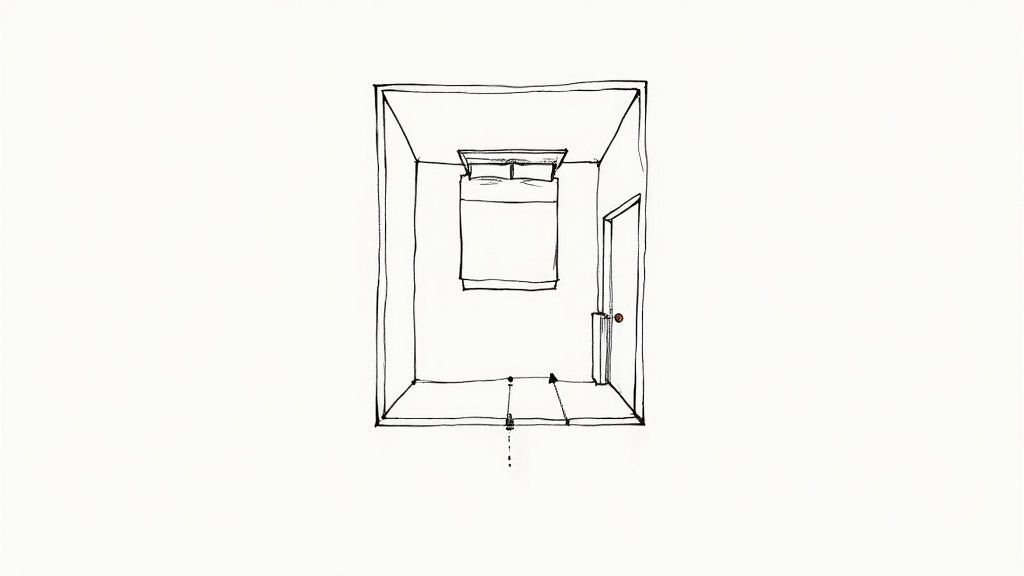
Your bedroom is your personal sanctuary, a space designed for rest and rejuvenation. How you position your bed sets the tone for the whole room, influencing everything from sleep quality to your overall sense of well-being. Getting this right is the first, most crucial step toward creating a space that truly feels like a retreat.
The commanding position isn’t just an interior design trick; it’s rooted in our instinct for safety. When you can see the entrance from your bed, your mind can relax, knowing you won’t be caught off guard. This simple layout choice helps quiet subconscious noise, paving the way for deeper, more restorative sleep.
The Psychology of a Well-Placed Bed
Think of your bed as the heart of your bedroom. When its position is right, the entire room clicks into place. This strategic placement offers several immediate benefits:
- Creates a Sense of Security: Have a clear view of the door to feel safe and aware of your surroundings. This allows you to fully let go and unwind.
- Establishes a Natural Focal Point: Your bed becomes the undeniable centerpiece, which makes arranging other furniture feel intuitive and balanced.
- Improves Room Flow: A thoughtfully placed bed eliminates awkward pathways, making the room feel more open and easy to navigate.
The impact of this decision is reflected in the global bedroom furniture market, valued at a staggering USD 266.15 billion. Beds are the cornerstone of this market, proving how vital this single piece of furniture is to creating a home.
For a quick reference, here’s a breakdown of what makes the commanding position so effective.
The Commanding Bed Position at a Glance
| Attribute | Advantage | Actionable Tip |
|---|---|---|
| Visibility | You have a clear, unobstructed view of the room’s entrance, which promotes a feeling of safety and control. | Position the bed diagonally from the door, not directly across from it, to avoid feeling too exposed. |
| Support | Placing the headboard against a solid wall provides a sense of stability and grounding. | Avoid placing a bed under a window if possible, as it can create a sense of vulnerability. If you must, use a tall, solid headboard. |
| Room Flow | It naturally establishes the room's primary focal point and creates logical pathways around the furniture. | Ensure you can walk around both sides of the bed. If not, consider a corner placement, but know it's a compromise. |
Ultimately, this approach is about more than just aesthetics; it's about designing an environment that supports your well-being.
Your bed’s location is the silent architect of your peace of mind. By placing it thoughtfully, you’re not just decorating a room—you’re designing a better night’s sleep.
If you want to dive deeper into the science behind it all, you can learn more about how bed placement impacts your sleep quality.
How to Find Your Room's Focal Wall
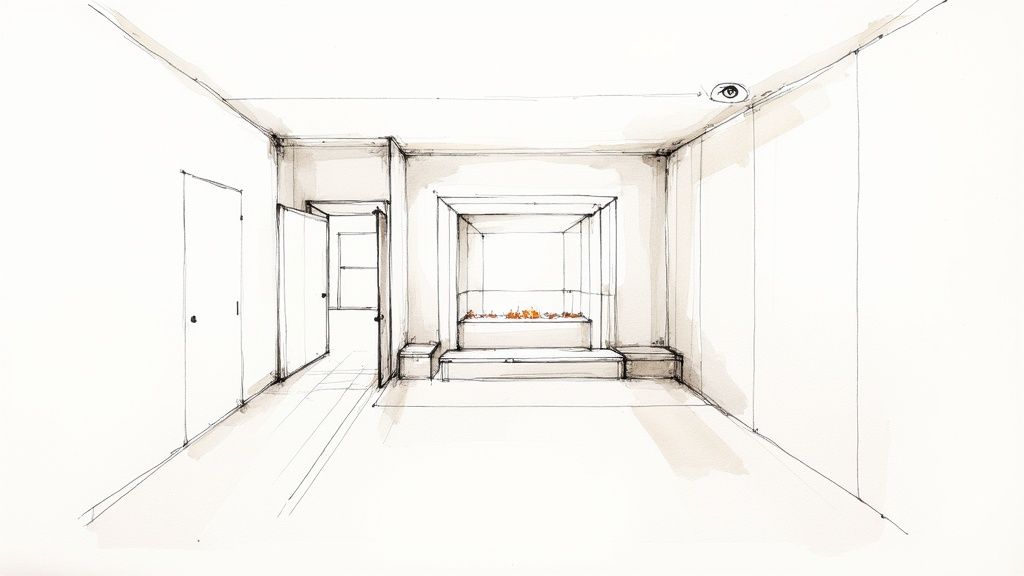
To find the best spot for your bed, you first need to identify your room's focal wall. This is your room's main stage—the very first place your eyes land when you walk in. Placing your bed here makes a statement. It anchors the entire space and brings a sense of calm and order.
This is the first step in learning to see your room like a designer. Once you know how to read your room’s natural architecture, you stop simply filling a space and start intentionally creating a sanctuary. This single decision makes your bed placement feel thoughtful and balanced.
Reading Your Room's Cues
So, how do you find it? Stand at your bedroom door and see where your eyes land naturally. The wall that pulls your gaze or feels the most substantial is almost always your answer.
Look for one of these three options:
- The First Wall You See: This is often the wall directly across from the doorway. Placing your bed here creates a welcoming vignette the moment you step inside.
- The Longest Unbroken Wall: A long, solid wall with no doors or windows offers the perfect grounding backdrop for a headboard. It gives you plenty of room to flank the bed with nightstands and art.
- A Wall with Architectural Features: If you have a fireplace, a large window, or a unique niche, use it. These are natural attention-getters and make a spectacular focal point.
Choosing a focal wall is like casting the lead role in a play. It’s the star that all the other elements will support, creating a cohesive and compelling story for your room.
Test Your Options
Once you've identified potential walls, visualize your bed against each one. Ask yourself: How does traffic flow around it? How does it feel to wake up facing that direction? A large window, for instance, can be a breathtaking backdrop, but you'll need good blackout curtains to ensure restful sleep.
A simple trick to make any focal wall feel more intentional is to add a mirror. A thoughtfully placed mirror not only bounces light around but also creates an illusion of depth. You can learn more about how to use floor-leaning mirrors to master this technique and introduce a touch of minimalist elegance.
Your goal is to find the wall that lets your bed be the hero of the room. Taking the time to get this right is the foundation for a bedroom that doesn't just look incredible but feels deeply restful.
Working Around Doors, Windows, and Closets
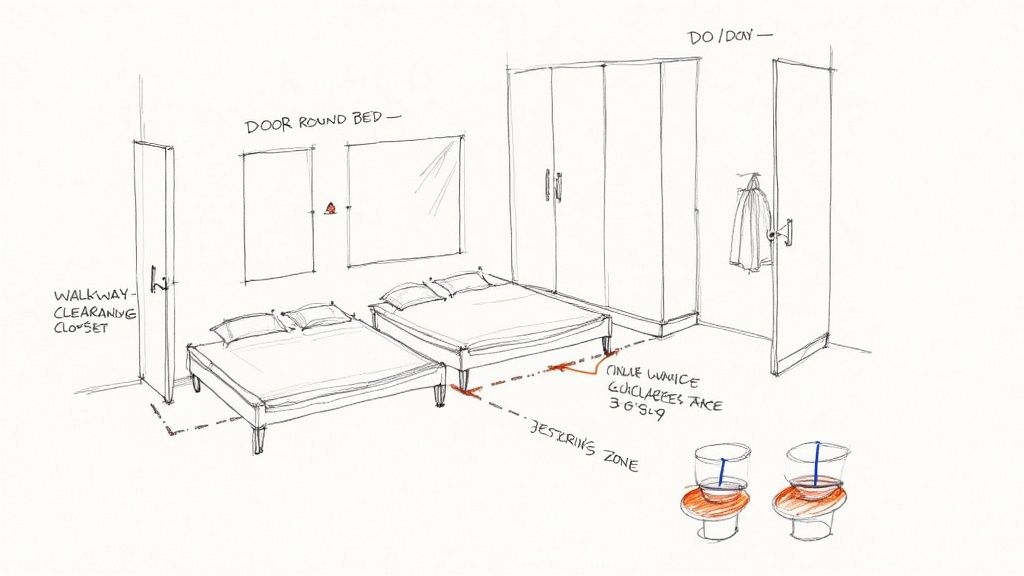
Real rooms have quirks—doors, windows, closets, and maybe an oddly placed radiator. Instead of seeing these as problems, think of them as guideposts. Learn to work with them, not against them, to create a layout that feels effortless and intuitive.
Above all, a bedroom needs to flow. A stunning room is useless if you’re constantly stubbing your toe. This is where clearances—the breathing room around your furniture—become your most important design tool.
Master Your Clearances
Think of clearances as the invisible pathways that make your room livable. Cramped walkways create subtle, daily friction and can shrink a room visually.
Here are the measurements you need to know:
- Primary Walkways: For any main path, like from the door to the closet, leave at least 30 to 36 inches of clear space. This is your non-negotiable standard for comfortable movement.
- Secondary Paths: For tighter spots, like between the foot of the bed and a dresser, you can shrink this down to 24 inches. Any less will feel like a pinch point.
- Door and Closet Swing: Use a tape measure to mark the full swing of your doors. Do not place any furniture within this arc to avoid constant irritation.
Getting these measurements right is what makes a space truly functional. In fact, strategic bed placement is a major consideration for homeowners globally. It dictates whether they can even fit essential pieces like nightstands and wardrobes, which, according to research on Statista.com, account for hundreds of millions of units sold every year.
Navigating Windows and Doors
With your pathways protected, it’s time to look at the walls themselves. Positioning your bed near windows and doors is a balancing act between aesthetics and security.
Can you place the bed under a window? Yes, but it comes with a trade-off. A low window behind your head can feel exposed. If it’s your only viable spot, choose a tall, solid headboard to act as a psychological buffer and create a sense of stability.
"Your room's architecture isn't a limitation; it's a built-in guide. Honor the natural flow around doors and windows, and your layout will feel intentional, not forced."
Here’s a hard and fast rule: never place your bed where it obstructs the doorway. Not only is it impractical, but it also creates a subconscious sense of being trapped. You want a clear line of sight to the entrance, not a roadblock.
By respecting these fundamental features, you transform potential layout headaches into a harmonious and deeply functional design.
Layout Solutions for Tricky Spaces
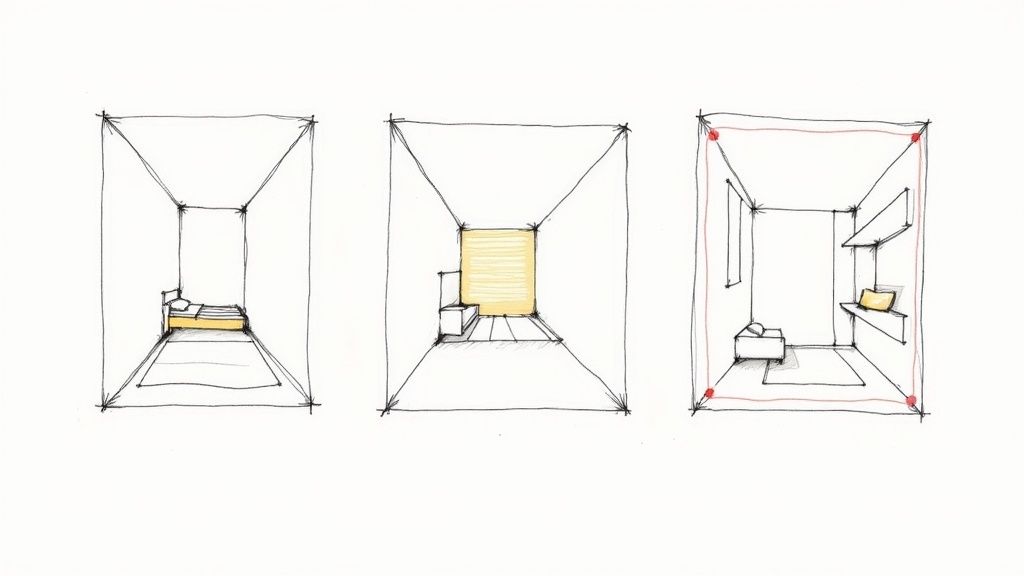
Small, narrow, or L-shaped rooms are an invitation to get creative. An awkward layout forces you to think outside the box, turning a challenge into a space brimming with character. Embrace your room's quirks and use them to your advantage. A thoughtful layout can make the smallest room feel open and the most oddly shaped room feel completely intentional.
Conquering the Narrow Room
To stop a long, narrow room from feeling like a hallway, place your bed against one of the longest walls. This immediately opens up a clear path on the opposite side, eliminating that cramped, corridor-like feeling.
To enhance the sense of space, follow these actionable tips:
- Use a Low-Profile Bed: A frame that sits closer to the ground creates more vertical space, making the ceiling feel higher.
- Install Wall-Mounted Lights: Sconces or pendant lights free up precious floor space that bulky nightstands would otherwise occupy.
- Choose Leggy Furniture: A dresser or bench with visible legs creates an illusion of openness by letting you see more of the floor.
Before you start rearranging, get a solid grasp of understanding bed dimensions and layout ideas to ensure everything fits just right.
Maximizing the Small Square Room
In a small, boxy room, the goal is to create a cozy nook rather than fighting for a sense of grandeur. Push the bed into a corner to save a significant amount of floor space for a small desk or a reading chair. While this breaks the "rule" of having access to both sides, the functional trade-off is often worth it.
To make this placement feel deliberate, treat the corner as a design feature. Pile on plush pillows and soft textiles to create a warm, nest-like retreat. It’s one of many creative ways to make a compact area feel both functional and inviting. Our guide on how to decorate small spaces has even more inspiration.
Your room’s unique shape isn’t a problem to be solved; it’s a personality to be celebrated. The most beautiful layouts are born from creative solutions to real-world constraints.
Creating Balance with Furniture and Decor
With your bed positioned, it’s time to bring in the supporting cast. A harmonious bedroom is about how every other piece of furniture and decor plays off the bed, creating a deep sense of order and flow.
Think of your bed as the sun in your personal solar system. Your nightstands, rugs, and lighting are the planets, all held in a perfect, balancing orbit. This is where you transform a functional room into a true sanctuary.
Anchoring Your Bed with Symmetry and Scale
Start with the pieces right beside your bed, as they make the biggest impact. Nightstands should feel like a natural extension of your headboard. For correct scale, choose nightstands that sit at or just below the height of your mattress top. This creates a clean, uninterrupted visual line.
Underneath it all, the right rug acts as the perfect anchor. It defines the entire sleeping area, grounding the space while adding a crucial layer of softness and texture.
Follow these steps for perfect rug placement:
- Get the Size Right: Your rug should extend at least 18 to 24 inches out from the sides and foot of your bed.
- Position it Correctly: Place the rug under the bottom two-thirds of the bed, stopping just short of your nightstands. This grounds the bed without swallowing the room.
Your bed sets the stage, but the surrounding furniture tells the story. Each piece should complement the other in scale and purpose, creating a silent dialogue of balance and harmony.
Layering Light for Ambiance
Lighting can completely transform the feel of a bedroom. Instead of relying on a single, harsh overhead light, think in layers. Layering your light sources builds a warm, inviting ambiance and gives you the flexibility to set the mood.
Incorporate this trio of light sources:
- Ambient Lighting: This is your primary, overall light, usually a soft ceiling fixture.
- Task Lighting: This is your focused light. Use matching table lamps on your nightstands or install sleek wall sconces for bedtime reading.
- Accent Lighting: A beautiful floor lamp tucked in a corner or a subtle light washing over a piece of art adds depth and a final touch of warmth.
Getting these elements to work together is what takes a room from simply furnished to beautifully designed. If you appreciate how clean lines and minimalist forms can create a powerful sense of calm, you'll find endless inspiration in the principles of Italian contemporary bedroom furniture to achieve that serene and balanced aesthetic.
Timeless Wisdom from Feng Shui Principles
Great design often just feels right. That intuitive sense of calm isn't an accident. It frequently taps into ancient wisdom like Feng Shui, a practice dedicated to creating harmony between you and your environment.
At its heart, Feng Shui is about guiding positive energy—or "chi"—through your home to enhance your well-being. And nowhere is that more important than the bedroom, your sanctuary for rest and renewal.
The Power of the Commanding Position
The cornerstone of Feng Shui bed placement is the commanding position. This simply means placing your bed where you have a clear view of the bedroom door, but you aren't directly in line with it.
This setup gives you a subconscious feeling of security and control, allowing your mind to switch off and your body to relax. It also calls for a solid wall behind your headboard, offering a sense of stability and support.
“In Feng Shui, a solid headboard against a sturdy wall provides a sense of stability and protection while you sleep, anchoring your energy and promoting deeper rest.”
Key Principles for Harmonious Sleep
Beyond the commanding position, follow these time-tested guidelines to elevate your bedroom from just a room to a true retreat.
-
Avoid the "Coffin Position": Never have your feet pointing directly out the door while you sleep. This is considered the most draining position, believed to pull your energy away from you.
-
Create Balanced Space: Leave open space on both sides of the bed if possible. This simple act fosters a sense of equality and balance, inviting good energy to flow freely.
-
Minimize "Sha Chi": Be mindful of sharp corners from dressers or nightstands pointing at you in bed. In Feng Shui, these are seen as "poison arrows" that can disrupt your peaceful energy. If you can't move the furniture, soften the corner with a plant or draped fabric.
By weaving these simple ideas into your layout, you’re crafting a sanctuary that truly supports your mind and body.
Your Bed Placement Questions, Answered
Even after you’ve absorbed all the design rules, every room presents its own unique puzzle. It’s completely normal to have a few lingering questions when you’re trying to perfect the heart of your home. Let's tackle the common "what ifs" so you can place your bed with absolute confidence.
Can I Really Put My Bed in Front of a Window?
I get this question all the time. While a solid wall is the textbook answer, sometimes the best solution is right in front of a window. Don't be afraid of it! The trick is to make it feel intentional and just as stable as a solid wall.
Here’s how to do it right:
- Get a Tall, Solid Headboard: It creates a visual anchor, essentially acting as the "wall" you need. This provides the sense of security and support we all crave.
- Layer Your Window Treatments: This is non-negotiable. Use floor-to-ceiling drapes or high-quality blackout blinds. They give you complete control over light and privacy, which is crucial for a peaceful night's sleep.
When you do it this way, the window becomes a stunning frame for your bed, turning a potential design challenge into a breathtaking focal point.
How Much "Breathing Room" Does a Bed Actually Need?
Clearance is everything. It's the invisible element that makes a room feel either gracefully spacious or frustratingly cramped. As a golden rule, aim for at least 30 inches of open space on both sides of the bed and at its foot.
This isn't just a random number; it's your personal pathway. It's what allows you to move freely, make the bed without a struggle, and open closet doors and drawers with ease. It's the room's sigh of relief.
Now, if you're working with a truly compact space, you can probably squeeze by with 24 inches. I wouldn't recommend going any tighter than that, though. Any less, and you'll start to feel the squeeze in your daily routine.
Is Putting a Bed in the Corner a Design Sin?
Let's be real: sometimes, you just have to do what works. Pushing a bed into a corner is a go-to move for saving space, but it has downsides. Making the bed becomes a mini-workout, and the person on the inside can feel a little hemmed in.
But if it’s the only logical option for your layout, then own it! Turn that corner into the coziest, most inviting nook imaginable. Pile on the pillows, drape a soft throw, and make it feel like a deliberate, comforting retreat. It's a perfectly good solution when practicality has to win.
At Griseo Interior, we believe a thoughtfully designed space is the first step toward a more beautiful life. Elevate your sanctuary with our collection of minimalist, made-to-order décor, crafted with Italian artistry and sustainable practices. Discover timeless pieces at https://griseointerior.com.