

A Practical Guide to Choosing Your Coffee Table from Italy
When you choose a coffee table from Italy, you're not just buying furniture; you're making a strategic design investment. To ensure you select the right piece, focus on the core elements that define Italian quality: superior materials like Carrara marble and rich walnut, innovative sculptural forms, and flawless craftsmanship. This guide provides actionable steps to help you identify, style, and care for a coffee table that will anchor your living space for a lifetime.
How to Identify Authentic Italian Coffee Table Design

Before you invest, you need to know what to look for. An authentic Italian coffee table has the power to elevate a room from simply being furnished to feeling thoughtfully curated. This guide will walk you through the practical steps of identifying a genuine piece. We'll explore these tables as functional sculptures, teaching you how to spot the blend of meticulous, old-world craftsmanship and daring, modern vision that ensures your coffee table from Italy is built not for a season, but for a lifetime.
Step 1: Understand the Legacy of Artistry and Innovation
To spot quality, you first need to understand its roots. For centuries, Italian artisans have mastered shaping natural materials. This tradition is the bedrock of contemporary Italian design. Your first action is to train your eye on the details: look for the gentle arc of a table leg, the invisible seam where wood meets stone, and the glass-like finish on a marble top. These are the signatures of deep-seated passion.
Italian designers expertly balance tradition with innovation. They respect time-honored techniques while pushing creative boundaries. When assessing a piece, ask yourself if the design feels both classic and fresh—this is a key indicator of authentic Italian design.
Actionable Tip: When you examine a piece of Italian furniture, look for one detail that showcases exceptional skill—like a perfectly book-matched marble slab or a complex wood joint. This small element often reveals the overall quality of the entire piece.
Step 2: Recognize It's a Statement of Intent
Placing an Italian coffee table in your home is a conscious decision. It’s a statement that you value enduring quality over disposable trends. To ensure the piece makes the right statement in your space, evaluate it against these practical criteria:
- Emotional Resonance: Does the piece evoke a feeling? Look for a design that resonates with your personal style, whether it’s warmth from wood or drama from marble.
- Uncompromising Quality: Inspect the materials. Are they substantial? Hand-select blocks of marble and premium wood grains are non-negotiable for high-end pieces.
- Functional Sculpture: Ask yourself: is this as useful as it is beautiful? The best Italian tables serve daily needs while acting as a source of inspiration.
For a deeper dive into this unique design philosophy, learn more about what "Made in Italy" design truly signifies. This knowledge will equip you to see your home's centerpiece in an entirely new light.
A Buyer's Guide to Spotting an Authentic Italian Coffee Table
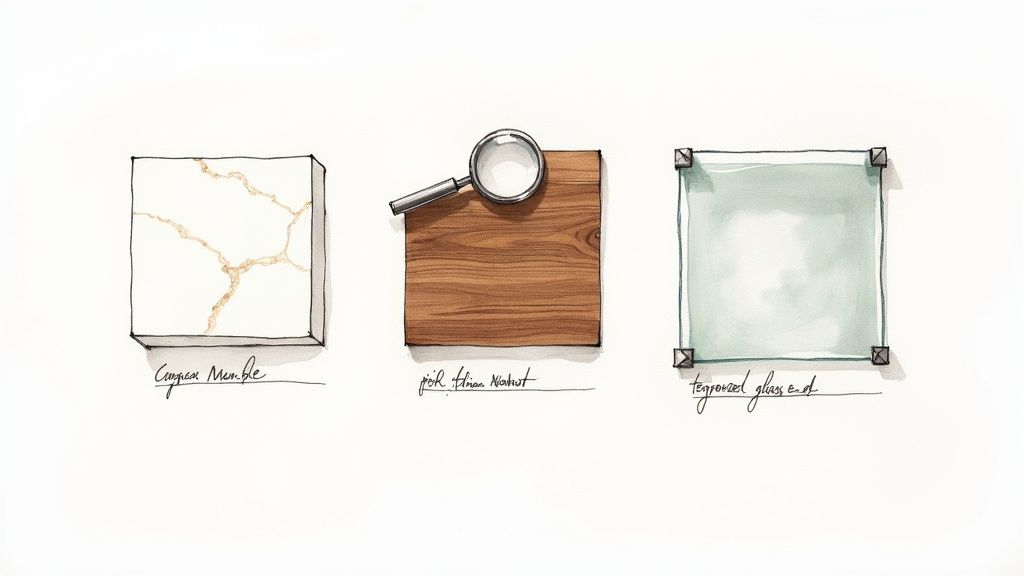
So, how do you distinguish a true Italian masterpiece from an imitation? Learning to spot authenticity is a practical skill. Think of it like a checklist: by evaluating materials, form, and craftsmanship, you can confidently invest in a piece that will bring you joy for a lifetime. An authentic coffee table from Italy isn't just an object; it's the result of an artistic process you can learn to identify.
How to Evaluate Masterful Materials
The soul of an Italian coffee table comes from its raw materials. Italian artisans have a profound connection to the stone, wood, and glass they shape. Your first step is to get hands-on.
Here’s a practical checklist for assessing the most iconic materials:
- Italian Marble: Don't just look for "Carrara." Feel the surface—it should be cool and solid. Examine the veining; it must be organic and fluid, never printed or repetitive. Tilt it in the light to see its unique luster.
- Solid Wood: Inspect the grain of woods like walnut or oak. It must be continuous, flowing seamlessly around edges. Avoid anything with visible veneer seams or a plastic-like finish. Knock on it—it should sound solid, not hollow.
- Glass and Metal: Look for crystal-clear glass, free of the common greenish tint unless it's a specific design choice like Murano glass. Test the weight of metal components; they should feel substantial and be integrated flawlessly, not feel lightweight or tacked on.
How to Judge Sculptural Form
Italian design is intentional. Every line, curve, and angle creates a sense of balance. An authentic piece actively engages with the space around it.
When assessing a table’s form, ask these practical questions:
- Does it have a distinct silhouette? The overall shape should feel confident and resolved, whether it’s minimalist or organic.
- How do the parts connect? Pay close attention to joints and intersections. They should be elegant and purposeful, not clunky.
- Does it look stunning from every angle? Walk around the table. A well-designed piece is considered from all viewpoints. Don’t just view it from the sofa.
Actionable Tip: A genuine Italian coffee table has "visual rightness." Its design doesn't shout for attention; it earns it through perfect proportions and thoughtful details. If something feels slightly off, trust your instinct.
How to Verify Flawless Craftsmanship
This is where true mastery reveals itself. Impeccable craftsmanship is the non-negotiable signature of authenticity. This commitment to quality is a major driver behind the growth of Italy's luxury furniture market.
The global demand for this artisanship is clear, with the Italian furniture market projected to hit USD 21.34 billion by 2025. This growth is particularly strong in the premium segment and in Central Italy, where historic workshops and modern design schools collaborate. You can explore more data about the growing Italian furniture market to understand the investment value.
To spot superior craftsmanship, become a detail detective. Use this checklist to evaluate a piece like a professional.
Authenticity Checklist for Italian Coffee Tables
Use this reference to quickly identify the hallmarks of genuine Italian design and craftsmanship before you buy.
| Key Characteristic | What to Look For | Why It's a Sign of Quality |
|---|---|---|
| Seamless Joints | Run your hand along edges and where materials meet. There should be no gaps, glue residue, or rough spots. | Shows precision engineering and painstaking assembly, a hallmark of handcrafted work. |
| Material Honesty | Marble has unique, non-repeating veins. Wood grain is continuous. Metal feels solid, not hollow. | Authentic materials are celebrated for their natural character, not hidden under artificial finishes. |
| Perfect Finish | Whether high-gloss or matte, the finish should be perfectly even, deep, and free of bubbles or drips. | A flawless finish requires multiple, meticulous steps and reflects an artisan's patience and skill. |
| Balanced Proportions | The table looks harmonious and intentional from every angle. Nothing feels out of place or awkward. | This "visual rightness" is a core principle of Italian design, achieved through experience, not accident. |
| Subtle Branding | Look for a discreet maker's mark, stamp, or certificate of authenticity, often hidden underneath. | Reputable artisans and brands proudly (but subtly) sign their work, guaranteeing its origin. |
These small points of perfection are the clearest signs of a piece made with passion and pride. They are the indicators of quality that separate the good from the truly exceptional.
How to Style Your Italian Coffee Table Like a Pro
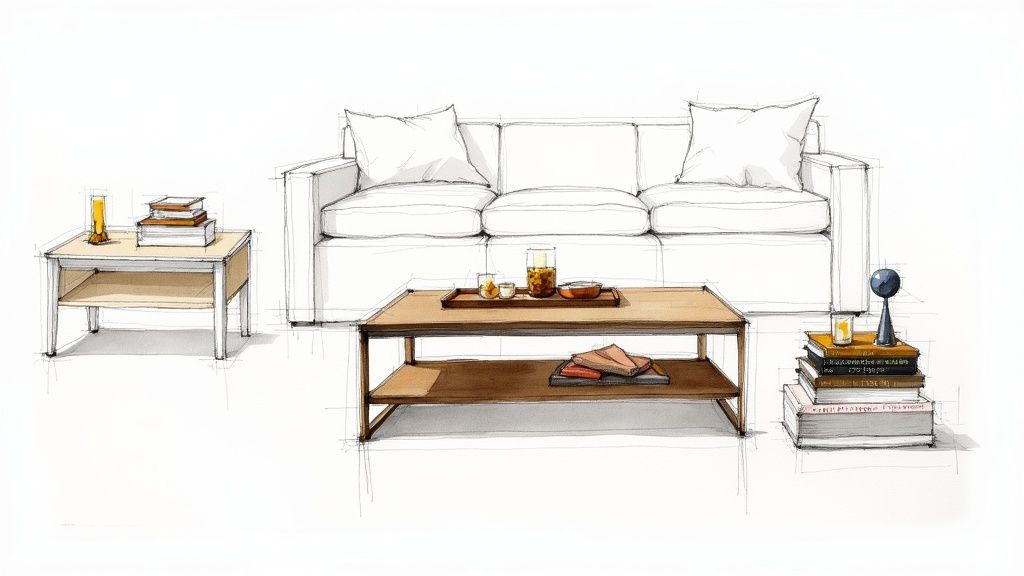
Bringing home a beautiful coffee table from Italy is the first step. The real magic happens when you style it, transforming it into the heart of your living space. This is not about rigid rules but about practical principles that help you create a surface that’s both personal and impeccably designed. The goal is a composition that feels intentional yet effortless.
Step 1: Achieve Perfect Scale and Balance
Before placing any objects, step back and consider scale. An Italian coffee table often has a strong, sculptural presence. Your decor should honor that, not fight it.
First, evaluate the visual weight of your surrounding furniture. A large, plush sofa can support a more substantial styling arrangement, while a sleek, minimalist sofa pairs better with just a few delicate pieces. This ensures your table feels integrated, not like a cluttered island.
Actionable Tip: Don't clutter the entire surface. Use a large tray to group smaller items. This practical tool anchors your decor and creates a single, unified statement while keeping things organized.
Step 2: Use Curated Styling Recipes for Every Material
Let the table's material guide your styling choices. Each finish offers a unique canvas. For those who want to visualize their choices digitally before committing, exploring a practical guide to 3ds Max interior design can be an incredibly helpful tool.
Here are three practical styling "recipes" to get you started:
- For a Serene Travertine Table: The earthy nature of travertine calls for organic textures. Your shopping list: a rough ceramic vase, a single large leaf (like a monstera), a small stack of linen-bound books, and a handcrafted wooden bowl. Keep the color palette muted to let the stone shine.
- For a Warm Walnut Table: The rich tones of walnut create an inviting mood. Your shopping list: large-format art books, a small personal object like a brass magnifying glass, and a scented candle in an amber glass jar. This layering technique creates a cozy, sophisticated feel.
- For a Dynamic Marble Table: With its dramatic veining, a marble coffee table from Italy is a work of art. Styling here is about contrast. Your shopping list: a sleek, modern vase, a vintage Murano glass bowl, and a book with a colorful spine. Mix eras and textures to create a dynamic look that feels collected over time.
Step 3: Master Layering and Personality
The most captivating coffee tables have layers of interest. Achieve this by strategically playing with height, texture, and personal items. A well-styled surface is never flat.
Here’s a simple 4-step process for building layers:
- Start with an Anchor: Begin with your largest item—a stack of books or a tray. This creates a foundation.
- Add Vertical Height: Introduce a taller object, like a vase with branches or a sculptural candle holder, to draw the eye upward and prevent a flat display.
- Incorporate Natural Elements: A touch of green from a plant or fresh flowers instantly adds life and softness.
- Finish with a Personal Touch: Add one unique object that tells a story—a piece from your travels, a family heirloom, or a favorite trinket. This makes the styling truly yours.
Ultimately, your coffee table should be a beautiful and functional reflection of your life.
How to Navigate Your Purchase Confidently
Purchasing a genuine Italian coffee table is a journey into artistry, and understanding the process will help you invest with confidence. You’re not just buying furniture; you’re commissioning a piece of your home’s story. The price of an authentic piece directly reflects its value—a blend of exceptional materials, brilliant design, and priceless artisan skill.
Understanding the Investment
What exactly are you paying for? The price tag on a true Italian coffee table is built on tangible quality and heritage. Here's a breakdown:
- Rarity of Materials: A table carved from a single block of Calacatta Gold marble will be a more significant investment than one from a common stone. The cost reflects the scarcity and quality of the raw material.
- Artisan Skill and Hours: The human expertise poured into each piece is immense. Even a simple-looking design with invisible joinery requires many hours of painstaking work. You are investing in a craftsperson's lifetime of skill.
- Designer Provenance: A piece from one of the iconic Italian furniture brands carries a legacy. This design heritage adds to its value, marking it as a collectible object. To familiarize yourself, review our guide to the top Italian furniture brands.
This dedication to quality is in high demand. The global market for high-end coffee tables is projected to reach $4,850 million by 2025. Searches for terms like 'Italian marble coffee table' often surge around the holidays, proving the desire for these statement pieces.
Embracing the Beauty of Slow Luxury
One of the biggest practical shifts when buying Italian furniture is accepting the lead time. High-end pieces often take several weeks or even months to arrive. This isn’t a flaw; it’s a feature and a sign of quality. This is slow luxury—a deliberate move away from mass production toward a more meaningful, made-to-order philosophy.
Actionable Insight: When you commission a piece of Italian furniture, you are not simply placing an order. You are initiating a creative process. Your patience is rewarded with an object crafted specifically and uniquely for you.
This made-to-order approach has tangible benefits. It guarantees that every detail is executed to the highest standard. It's also more sustainable, eliminating the waste from overproduction. Your table doesn't exist until you ask for it. The wait becomes part of the story, ensuring you receive a future heirloom that is not only beautiful but also crafted responsibly.
Caring For Your Investment: A Practical Maintenance Guide
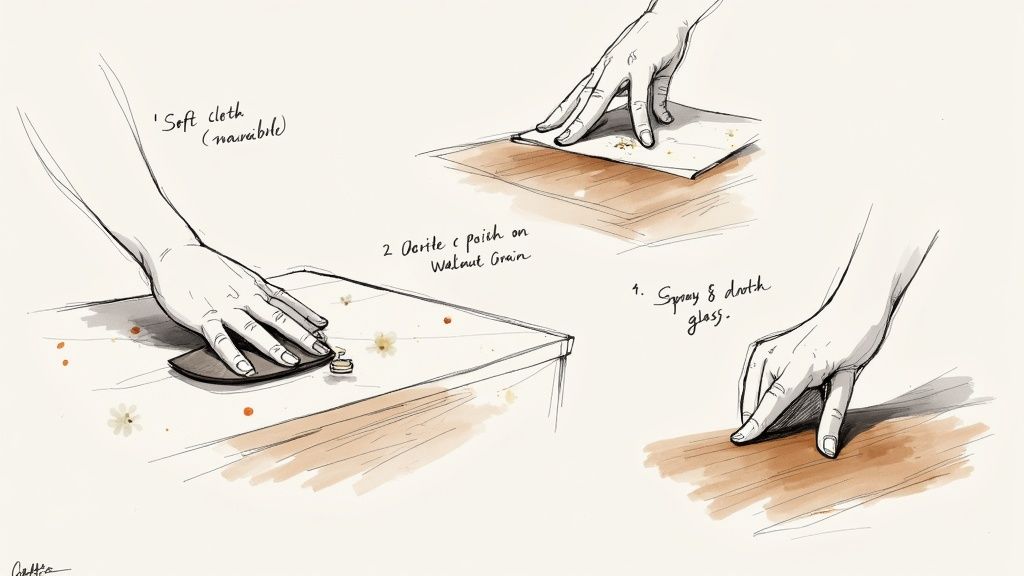
An authentic Italian coffee table is a future heirloom. Protecting this investment is about forming a few simple, mindful habits. This turns maintenance from a chore into a rewarding ritual, ensuring your table’s character deepens with time. The secret is understanding the needs of each material.
A Simple Guide to Natural Stone Care
Marble and travertine are porous and need proactive attention. Think of the surface like a fine silk shirt—strong but needing gentle treatment to avoid stains.
Your most important tool is speed. Wipe up spills from coffee or wine immediately with a soft, damp cloth. Acidic liquids like citrus juice or vinegar are the main threat, as they can etch the surface if left to sit.
Your Best Defense is a Coaster: Make this a household rule. It is the single most effective way to protect the pristine surface of your stone coffee table and prevent rings and discoloration.
For daily cleaning, use a pH-neutral stone cleaner. Avoid all-purpose cleaners, as their harsh chemicals can strip the sealant and dull the finish.
A Practical Routine for Wood Care
Wood brings organic warmth, and caring for it means protecting its finish. Your first step is to dust regularly with a microfiber cloth to prevent micro-scratches from accumulating.
For cleaning, a slightly damp cloth is usually all you need. For stickier spots, use a cleaner made specifically for finished wood. To enhance the grain, follow these steps for polishing:
- Choose the Right Polish: Use a high-quality furniture polish or wax that nourishes the wood. Avoid products with silicone, which can build up.
- Apply Correctly: Put a small amount on a clean cloth and rub it in, always moving with the grain.
- Buff to a Sheen: With a second clean cloth, gently buff the surface to reveal a deep, lustrous shine.
Knowing your specific wood type helps. For more detail, you can explore our guide on solid acacia wood and its care needs.
How to Maintain Pristine Glass and Metal
The crisp lines of glass and metal are a signature of modern Italian design. To clean glass tops, use a homemade solution of one part white vinegar to four parts water in a spray bottle. Spritz lightly and wipe with a lint-free microfiber cloth for a streak-free shine, avoiding the chemical residue of commercial cleaners. For metal bases, simply wipe with a damp cloth, followed by a dry one, to remove fingerprints and keep them looking sharp.
Your Final Questions Answered
Bringing a piece of Italian artistry into your home is a big decision. Here are answers to common questions to give you the final confidence you need to move forward. This isn't just a checklist—it's practical advice to help you make the right choice with excitement.
What’s the Typical Price for an Authentic Italian Coffee Table?
Expect a range. You can find well-made designs from respected brands starting around $1,500. For an iconic piece crafted from premium materials like a rare slab of marble, the investment can range from $5,000 to over $20,000. This price reflects the material cost, artisan hours, and design legacy. You are investing in a piece built to last and hold its value.
How Can I Be Sure a Coffee Table Is Truly Made in Italy?
First, ask for documentation. Reputable dealers will provide a "Made in Italy" certificate or details about the workshop. Research the brand or designer—authentic Italian makers have a rich history.
Actionable Tip: Trust your hands. An impeccably smooth finish and invisible joinery are the quiet hallmarks of master craftsmanship. These details are nearly impossible to fake and speak volumes about a table's origin.
Are These Coffee Tables Practical for a Home with Kids?
Absolutely. Italian furniture is designed for living. For a busy household, choose tables made from robust materials like solid wood or travertine, which are more forgiving than glass. Many modern finishes are also developed for durability. The key is to build good habits: using coasters and wiping up spills quickly will help your table handle family life beautifully.
Why Does It Take So Long to Get an Italian Coffee Table?
The wait is part of the "slow luxury" experience. Most high-end Italian coffee tables are made-to-order. The lead time—usually between 8 and 16 weeks—is a guarantee that artisans are dedicating their skill to crafting your specific piece. This bespoke process ensures a level of quality that cannot be rushed. The anticipation is for a future heirloom being made with intention, just for you.
At Griseo Interior, we believe your home should be a gallery of your life’s story, filled with objects that inspire you daily. Discover our collection of authentic, made-to-order Italian furniture and décor, and find the perfect centerpiece to begin your next chapter. Explore the collection at https://griseointerior.com.