

A Practical Guide to Sustainable Supply Chain Practices in Design
A sustainable supply chain isn't a complex set of rules; it's a series of conscious, actionable choices you make every day. From sourcing raw timber to delivering a finished piece, this guide provides a clear roadmap for implementing sustainable supply chain practices that are kind to the planet, fair to its people, and build a powerful legacy of integrity for your design studio.
Building a Greener Legacy in Design
A powerful shift is happening in the world of design. We're realizing that true luxury isn't just about how something looks, but about how it's made. Today’s clients aren’t just buying a piece of furniture; they're investing in its story—its origins, its journey, and its impact on the world.
This change in mindset isn't a burden. It’s an incredible opportunity for design studios to lead, innovate, and connect with clients on a much deeper level. Transparency and ethics have become the new cornerstones of trust.
A New Definition of Design Excellence
Excellence in design today is measured by more than aesthetics. It's about the thoughtful, conscious decisions made long before a design ever takes shape.
Think of the difference between a passing trend and a timeless heirloom. The heirloom’s value comes from its story—the sustainably harvested wood, the non-toxic finishes, the fair wage paid to the artisan. This is your chance to move beyond surface-level beauty and build a business as enduring as your designs.
Every choice matters in this connected system. Start implementing these principles with our practical guide on eco-friendly interior design, where we explore how to create stunning spaces with a lighter footprint.
Embracing the Circular Mindset
To truly build a greener legacy, you must rethink your relationship with "waste." Shift from the linear "take, make, toss" model to a circular approach where materials are kept in use for as long as possible. The primary action is to design waste out of the system from the very beginning.
A sustainable supply chain isn't a destination; it's a continuous journey of improvement. Start by asking better questions at every stage of your design and production process.
For a practical deep-dive, explore circular economy business models that are completely redefining how we create and consume. This mindset doesn’t just reduce waste; it turns it into a resource, creating a system that is both profitable and regenerative. It’s how you can build a business that not only sustains itself but actively nurtures the world around it.
Understanding Your Design Ecosystem
Let's start by ditching the term 'supply chain.' It sounds cold and industrial. Instead, think of it as your design ecosystem. This reframes your perspective, helping you see the vibrant, interconnected story behind every single piece you create and making sustainability a tangible goal.
Picture your work not as a straight line, but as a living circle. It begins in a responsibly managed forest, flows through the hands of a skilled artisan, and finds its place in a home for generations. When its first life is over, its materials are designed to be repurposed or returned to the earth, starting the cycle anew.
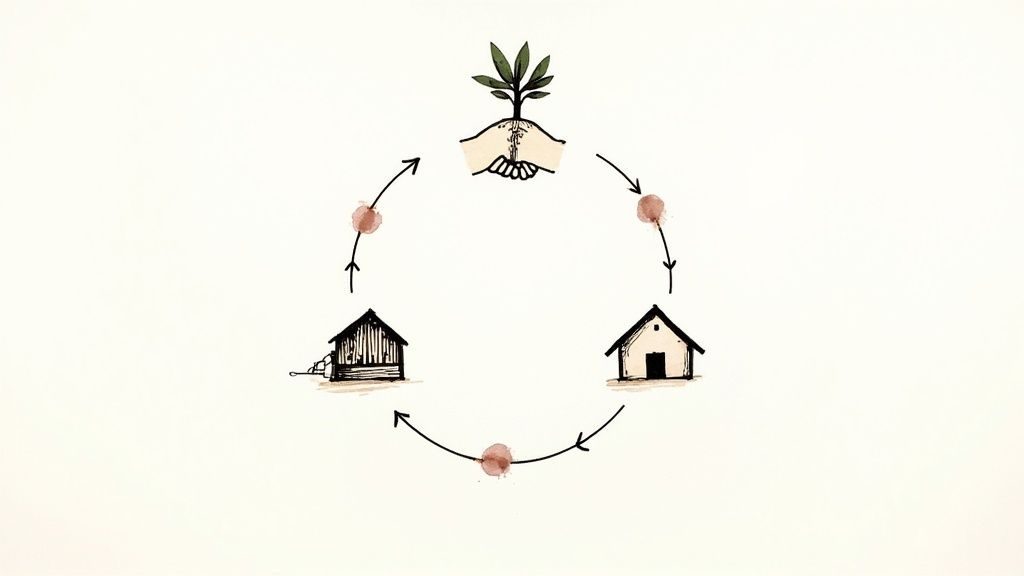
This ecosystem is built on three core principles. Balancing them is the key to building a business that’s not only successful but truly meaningful.
The Three Foundational Pillars
Think of these as the three legs of a stool—if one is weak, the whole thing topples. Integrating them into every decision you make is what allows your creative mission to flourish responsibly.
- Environmental Stewardship: The goal is simple: give back more than you take. Act on this by choosing materials that help regenerate the planet, using processes that leave air and water clean, and designing pieces built for a lifetime, not a trend cycle.
- Social Responsibility: This pillar is all about people. Take action by ensuring fair wages and safe working conditions. Build respectful, uplifting partnerships with every artisan, supplier, and team member who touches your work.
- Economic Resilience: True sustainability must be profitable. Build a smart, efficient business by implementing models like producing on-demand to slash waste, which allows your studio to thrive while making a positive impact.
This isn't an idealistic fantasy; it's a business necessity. A recent global survey found that 91 percent of Chief Procurement Officers have aligned purchasing with their company’s sustainability goals. This shift is happening everywhere, with most companies now openly reporting their data. You can learn more from this global supply chain sustainability analysis.
From Links in a Chain to Partners in a Mission
Adopting this ecosystem mindset changes how you manage business relationships. Your suppliers are no longer just vendors; they are partners in your creative mission. The artisan isn't just a contractor; they are a collaborator whose skill and well-being are essential to the final product's integrity.
To implement a sustainable supply chain, view every part of your process—from raw material to final client—as an interconnected and valuable part of a living system.
With this understanding, you can start asking practical questions: Where do my materials really come from? Who is making my products, and are they treated well? What is the real-world impact of my business? This foundational knowledge is the first, most crucial step toward building a brand that isn't just admired for its beauty, but respected for its character.
The Building Blocks of a Sustainable Supply Chain
Alright, let’s get practical. Moving from the idea of sustainability to doing it means breaking it down into real, actionable steps. This is where we shift from theory to practice.
These pillars are not a rigid checklist but a framework for a more responsible design business. Each one is an opportunity to make a deliberate choice that creates a positive ripple effect. By focusing on these five core areas, you can start building a business that truly reflects your values.

Regenerative and Ethical Sourcing
It all begins with raw materials. Action here means choosing resources that actively heal and support our planet and its people. This moves you away from a simple take-and-use mentality and toward a regenerative one.
Ethical sourcing requires you to investigate the full story of a material—where it came from, who handled it, and how it was harvested.
Here are actionable steps to start:
- Specify Certified Woods: Prioritize materials stamped with the Forest Stewardship Council (FSC) seal. This is your guarantee that the wood comes from responsibly managed forests that support the environment and local communities.
- Incorporate Recycled and Upcycled Materials: Actively seek out recycled metals, plastics, or fabrics. This drastically cuts demand for new resources and keeps valuable materials out of landfills.
- Explore Low-Impact Alternatives: Get creative and research options like fast-growing bamboo, renewable cork, or even mycelium (the root structure of mushrooms) for your projects.
Every conscious material choice weaves a story of respect for nature directly into your work.
Mindful Production and Artisan Partnerships
The next step is to challenge the wasteful model of mass production. Embrace a more intentional, human-centered way of creating that honors craftsmanship and stops waste before it starts. The goal: make only what is truly wanted and needed.
Adopting a made-to-order model is one of the most powerful actions a design studio can take. It eliminates waste by perfectly matching production to actual demand.
This approach prevents unsold inventory and lets you build real relationships with the artisans who bring your visions to life. Partnering with local makers injects money back into your community and helps keep craft traditions alive. To learn more, our guide on sustainable manufacturing practices explores how to reduce your footprint during the creation phase.
Low-Impact Studio Operations
Sustainability starts in your own studio. This pillar is about shrinking the environmental footprint of your day-to-day work. Small, consistent habits add up to massive positive change.
Think of your workspace as its own ecosystem. You have direct control over your energy, water, and waste.
Start with these straightforward actions:
- Improve Energy Efficiency: Swap old bulbs for LEDs, choose energy-efficient equipment when upgrading, and create a team habit of powering everything down at the end of the day.
- Implement Waste Reduction: Set up a comprehensive recycling and composting system. Conduct a "waste audit" for one week to see what you're throwing away—it's the best way to spot opportunities to reduce and reuse.
- Conserve Water: Install low-flow faucets and be more mindful of water use in cleaning and any production processes.
These operational tweaks prove that your commitment to sustainability runs through every part of your business.
Conscious Logistics and Packaging
How your creations get from point A to B matters just as much as how they were made. This pillar tackles the environmental cost of shipping and packaging. Your goal is to create an unboxing experience that feels special but is gentle on the earth.
Sourcing locally is a brilliant first step, as it immediately slashes transportation emissions. When shipping the final product, make your packaging as lean and green as possible.
Here are better packaging options to implement:
- Use Biodegradable Materials: Source compostable mailers made from cornstarch or protective inserts grown from mushrooms.
- Choose Recycled Content: Always select boxes and filler made from 100% post-consumer recycled content.
- Design Minimalist Packaging: Ditch unnecessary layers. Use smart branding that encourages customers to recycle or, even better, reuse the box.
Radical Transparency and Storytelling
The final, and perhaps most important, pillar is earning trust with your clients. In a world of vague "eco-friendly" claims, radical transparency is your superpower. Be upfront about your sourcing, production, and even the areas where you know you can still improve.
Use certifications like FSC or Fair Trade as proof, but don't stop there. Tell the stories behind your choices. Explain why you chose a specific artisan or why a material is special. When you do this, sustainability stops being a bullet point and becomes a core, unforgettable part of your brand's soul.
How to Measure What Matters
To make a real difference, move past good intentions and start measuring your actual impact. What gets measured gets managed. This isn't about complex corporate spreadsheets; it's about using a clear, straightforward way to see your progress and drive meaningful change.
Think of it less as a report card and more as a compass. By gathering the right data, you can celebrate your wins, pinpoint where you can improve, and tell a powerful story about your commitment.
Start with Simple, Actionable KPIs
You don't need a dedicated sustainability officer to begin. Focus on a few core metrics that are in your control and relevant to how a design studio works.
Here are three Key Performance Indicators (KPIs) you can start tracking today:
-
Percentage of Certified Materials: For each project, calculate the ratio of certified materials (like FSC-certified wood) versus uncertified ones. Set a tangible goal to increase this percentage over time to improve your sustainable supply chain practices.
-
Waste Diversion Rate: This metric shows how much waste you're keeping out of the landfill. To calculate it, divide the weight of everything you recycle, compost, or reuse by the total weight of your waste, then multiply by 100. It's a simple number that tells a big story.
-
Supplier Ethics Scorecard: Turn your gut feelings into a measurable tool. Create a simple scorecard for your main suppliers. Grade them on their environmental policies, commitment to fair labor, use of eco-friendly packaging, and their transparency.
Understanding Your Wider Footprint
Measuring what happens in your studio is crucial, but a huge piece of the puzzle lies in your supply chain. These are Scope 3 emissions—the carbon footprint of your raw materials and the fuel burned to deliver your finished pieces.
The greatest challenge—and opportunity—is the impact of the partners you choose. Understanding this is the first step toward genuine accountability.
This is where many businesses get stuck. Research shows that while around 40 percent of companies monitor their own direct emissions, far fewer measure their supply chain. This is a critical blind spot, since those emissions can make up roughly 75 percent of a company's total environmental footprint.
You don't need a costly analysis. Start by using free online carbon footprint calculators to get a solid estimate for a specific product. These tools provide insights into how your material and shipping choices add up. These same principles apply to our daily lives; our guide on how to reduce your carbon footprint at home has simple tips that translate perfectly to a small studio.
Your Roadmap to a Sustainable Transformation
Switching to a sustainable supply chain can feel overwhelming. We've broken it down into a straightforward, manageable roadmap designed to guide you. This is a practical framework for turning your intentions into measurable change.
Think of it like charting a course. Each phase builds on the one before it, helping you gain momentum and keep your final destination in sight.
Phase 1: Map Your Ecosystem
First, you need to see the whole picture. Before you can improve anything, you must understand it with total clarity. Trace the life of your products from their absolute origin—the raw timber, the spun fiber—all the way to your client's home.
This mapping process is about gaining awareness. Ask specific questions: Who are my main suppliers? Where do their materials come from? Which artisans and workshops bring my designs to life? This visibility is the crucial first step to spotting your biggest opportunities for impact.
Phase 2: Define Your Mission
With a clear map, it's time to set your destination. What does "sustainability" mean for your brand? This phase is about setting specific, achievable goals that resonate with your core values.
For example, set a goal to source 80% of your materials from certified, ethical suppliers within two years. Or, aim to completely eliminate single-use plastics from your packaging by next year. This is also the time to find your tribe. Actively seek suppliers and partners who are already on this path; their collaboration will be your greatest asset.
The most powerful sustainable supply chain practices are born from a clear, authentic mission. It transforms a list of tasks into a meaningful movement that inspires everyone involved.
As you define what matters most, it helps to understand different strategies. Learn about empowering a green supply chain to build a foundation for both environmental health and business success.
Phase 3: Implement and Innovate
Here’s where your vision becomes reality. With your map and mission, you can begin weaving new sustainable supply chain practices into your daily workflow. Small, intentional changes start to create big ripples.
Your action plan could be as simple as:
- Switch to Eco-Packaging: Don't try to change everything at once. Start by swapping one material, like replacing plastic bubble wrap with a recycled paper alternative.
- Introduce On-Demand Production: Test a made-to-order model with a single product line. See how clients respond and how it immediately cuts waste.
- Strengthen Supplier Dialogue: Start a conversation. Ask your key suppliers about their green initiatives and explore how you can support each other.
This shift is happening in a changing regulatory landscape. New rules are pushing companies to understand their entire value chain to sidestep risks. As recent supply chain research from S&P Global highlights, this turns sustainability challenges into opportunities for a stronger, more resilient business.
Phase 4: Share Your Story and Refine
Finally, a sustainable transformation shouldn't happen behind closed doors. This last phase is about bringing clients along on the journey and using their feedback to continually improve. Transparency builds trust and can turn customers into your most passionate advocates.
Share the stories behind your material choices and artisan partners. Be open about your progress and challenges. This authentic communication forges a powerful bond. At the same time, listen to feedback and use your KPIs to fine-tune your approach, ensuring your roadmap remains a living, evolving guide.
Putting Sustainable Practice into Action
It’s one thing to talk about big ideas, but seeing them work in the real world provides true inspiration. Let's look at what happens when a design studio weaves sustainability into its identity. This is the story of Griseo Interior, a studio proving that world-class design and deep respect for the planet are inseparable partners.
Their approach is a masterclass in conscious creation, blending cutting-edge technology with timeless Italian craftsmanship. What emerges is a system that fundamentally challenges an industry too often defined by waste.
The Power of the Made-to-Order Model
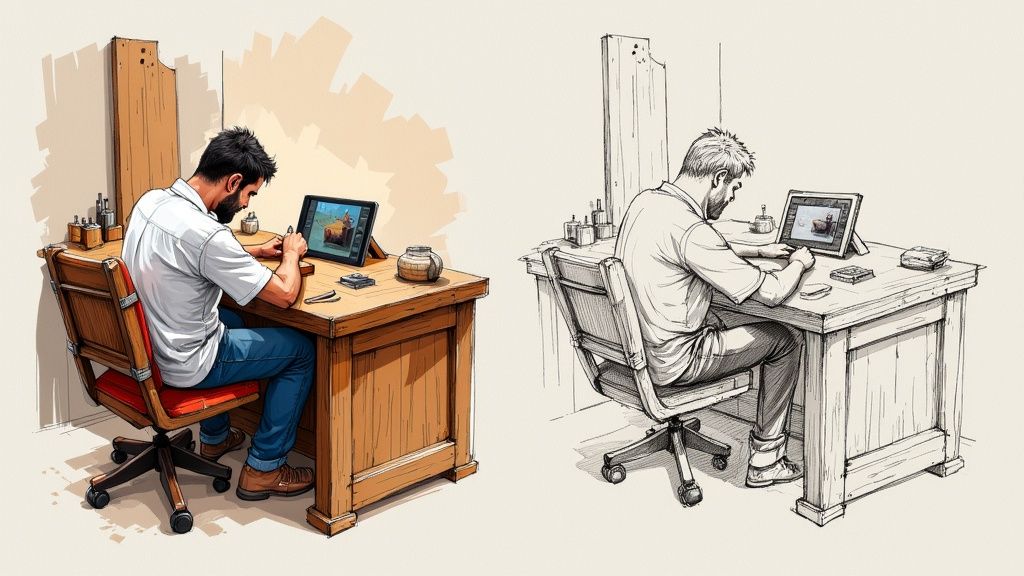
At the heart of Griseo Interior’s philosophy is a single, powerful commitment: producing only on demand. This is a direct answer to the staggering problem of overproduction. By creating each piece for a specific client, they eliminate excess inventory and the wasted resources that come with it.
This model blends digital precision with the human hand. A design is perfected digitally before a single piece of wood is cut. Only when an order is confirmed does physical creation begin, merging precise 3D-printing with the skills of artisans for the final touches.
"True sustainability in design isn't about sacrifice; it's about intention. By creating only what is desired, we honor our materials, our artisans, and our clients, ensuring that every object we produce has a purpose and a home."
This thoughtful process means not a single ounce of material is spent on a product that might just sit on a shelf. It’s a rebellion against throwaway culture, proving that patience and purpose are the new signatures of genuine luxury.
Championing Local Materials and Craftsmanship
This devotion to responsibility runs through their entire supply chain. Griseo Interior’s strategy rests on local partnerships—a choice that creates positive ripples through their environmental footprint and their community.
By prioritizing local and sustainable materials, they drastically cut transportation emissions. It also allows them to forge strong, personal relationships with suppliers, which is key to a transparent and ethical sourcing process.
Their work with skilled local artisans does more than guarantee exceptional quality; it breathes economic life into their region. This is one of the most inspiring sustainable supply chain practices any studio can adopt. It’s a move that:
- Preserves Heritage: It keeps ancient craft traditions alive and passes them to a new generation.
- Strengthens Local Economies: It creates stable, meaningful work for talented people in their communities.
- Reduces Environmental Impact: It shortens the journey from workshop to home, resulting in a lean, low-impact operation.
The story of Griseo Interior is a vibrant, living example of a new way forward—a testament to how a respected, purpose-driven brand can be built by weaving together stunning design, smart technology, and an unshakeable commitment to both people and planet.
Common Questions on Sustainable Design
Diving into sustainable design is exciting, but it naturally brings up practical questions. It's normal to wonder how these ideals translate to the reality of running your studio. Let’s tackle some of the most common concerns so you can move forward with confidence.
Is a Sustainable Supply Chain Really Affordable for a Small Studio?
Yes, it absolutely can be. While some certified materials may have a higher upfront cost, the real savings come from a holistic view of your business.
Practices like on-demand production eliminate the cost of unsold inventory and wasted materials—two of the biggest hidden expenses for small businesses. Sourcing locally also slashes high, unpredictable shipping fees. Think of it less as an expense and more as a smart investment in a leaner, more resilient business that attracts loyal, conscious consumers.
How Can I Actually Verify a Supplier's "Green" Claims?
This is a great question. With so much "greenwashing," a healthy dose of skepticism is your best friend. Look past the marketing and ask for tangible proof.
- Ask for certifications. Don’t be shy about requesting documentation. Legitimate credentials like FSC for wood or Fair Trade for labor are verified by outside experts, giving you real assurance.
- Request a tour. Ask if you can see their workshop, even virtually. A supplier who is genuinely proud of their process will be excited to show you. Transparency is a huge green flag.
- Start with a test order. Place a small, low-risk order first. This lets you experience their quality and communication firsthand before making a larger commitment.
Trust is built on transparency. A good partner will welcome your questions.
The heart of sustainability is curiosity. A willingness to ask "why" and "how" is your most powerful tool for building a supply chain you can truly believe in.
My Go-To Suppliers Are Traditional. Where Do I Even Start?
This is an opportunity, not a hurdle. Many traditional artisans have been using sustainable methods for generations—they just don't use modern buzzwords for it.
Start a conversation instead of making demands. Share your vision for responsible design, then ask about their process. You might learn they already use low-impact finishes or source wood from a local family-owned mill. Frame it as a partnership. You can grow together, and you might even be able to help them get a certification that opens up new doors for both of you.
How Do I Talk to My Clients About All This?
Lead with the story, not a sermon. Your clients are hiring you for your design eye, so weave your sustainable choices into the narrative of beauty and quality.
Instead of making it feel like an obligation, share the magic behind their piece. Talk about the journey of the reclaimed wood you used or the incredible skill of the local artisan who brought the design to life. When clients see that sustainability adds a layer of soul, history, and unmatched quality, it stops being a compromise and becomes one of the most exciting features of your work.
Ready to bring intentional, sustainable design into your own space? At Griseo Interior, every piece is crafted on demand with a deep respect for materials and artistry. Explore our collections and discover the beauty of conscious creation at https://griseointerior.com.