

Wall Unit Modular: Your Guide to Stylish, Efficient Storage
What if your living space could breathe, shift, and grow right along with you? That's the magic behind a wall unit modular system. It’s a dynamic approach to furniture where your storage and display adapt to your life, not the other way around. Think of it as a collection of individual building blocks you can combine and arrange to create a custom solution that's perfectly fitted to your home.
The Modern Revolution of Adaptable Furniture
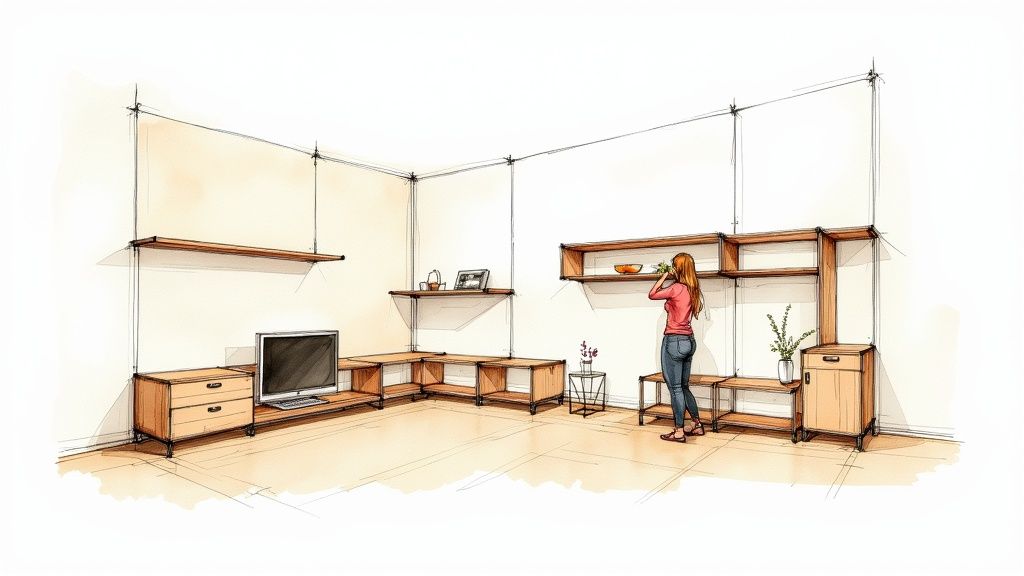
We're moving into a world where furniture is no longer static, but a fluid part of your home’s story. A modular wall unit isn't just a set of shelves; it’s a lifestyle choice. Use it to solve your unique challenges—from making the most of a compact city apartment to designing storage for a spacious family house.
This guide provides actionable advice for designing a system that works for you. We'll go beyond the basics to help you select, configure, and install a unit that solves your storage problems and reflects your personal style.
Why Modularity Matters Today
The need for living spaces that can keep up with us has never been greater. A modular system gives you a beautiful blend of structure and freedom, putting you in the driver's seat as the architect of your own environment. This flexibility is a cornerstone of modern interior design.
The core promise of a modular wall unit is simple yet powerful: it offers a bespoke solution without the bespoke price tag, allowing your space to evolve as your needs and tastes change over time.
Here's how to leverage the benefits of a modular system in your home:
- Ultimate Personalization: Start by listing what you need to store and display. Then, mix and match components—from sleek cabinets and open shelves to integrated desks and drawers—to build a unit that serves your exact needs.
- Future-Proof Design: Think long-term. Choose a system that can be reconfigured, expanded, or moved to a new home. This makes it a sustainable and cost-effective investment.
- Maximized Space: Identify underused wall space in your home. By building vertically, you can turn awkward nooks and empty walls into functional and beautiful features. This same spirit of smart design is seen in other pieces like multifunctional home office furniture.
To see how these incredible systems come to life in contemporary spaces, take a look at our deeper dive into the benefits of modern wall units.
Understanding the DNA of a Modular System
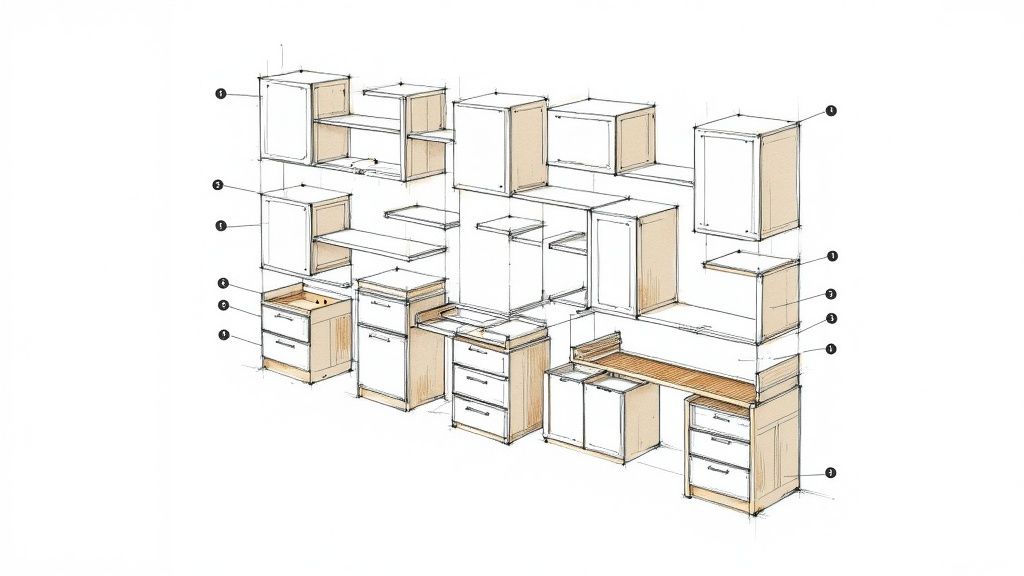
At its heart, a modular wall unit is a collection of sophisticated building blocks for your home. Instead of a single piece of furniture, think of it as an architectural skeleton for your wall—a strong framework you can customize with components that fit your life. This gives you both structural integrity and complete aesthetic freedom.
The core idea is beautifully simple. Instead of being stuck with one large, unchangeable cabinet, you get a set of individual, interconnecting elements. Your first step is to learn the function of each component to design a custom solution for your unique challenges, whether that’s organizing a media center, carving out a home office, or creating a gallery for collected treasures.
The Essential Building Blocks
Every great creation begins with its fundamental parts. For a modular wall unit, these pieces are your creative palette. Familiarize yourself with their roles to bring your perfect configuration to life.
Most systems are built from a handful of key elements:
- Vertical Supports: Choose your unit's backbone. These can be floor-to-ceiling poles, sleek wall-mounted rails, or freestanding panels that create the primary structure.
- Shelves: Select shelves for open storage. Use them for books, art, and electronics. Vary depths and lengths to create a dynamic visual composition.
- Cabinets: Opt for cabinets with doors to keep items out of sight. They’re perfect for hiding clutter and maintaining a minimalist look.
- Drawers: Add drawers to organize smaller items like documents or device chargers. They keep everything neatly tucked away and easy to find.
This deep desire for personalization is completely reshaping the furniture industry. Wall units were a massive $100 billion market in 2023, and that number is expected to climb to an incredible $168.37 billion by 2032. What’s driving this growth? Customization. A recent study found that 60% of consumers are now actively looking for tailored designs to fit their unique spaces. You can dive deeper into this trend by exploring the full market analysis on Introspective Market Research.
Fully Modular vs. Semi-Modular Systems
As you start exploring, you'll need to decide between fully modular and semi-modular systems. This choice comes down to how much flexibility you really want or need.
A fully modular system offers boundless freedom, letting you place any component at nearly any height or position. A semi-modular system provides curated flexibility within a more defined structure.
A fully modular system is the ultimate blank canvas. It uses a grid of pre-drilled holes or continuous channels along its vertical supports, letting you attach components with absolute precision. Choose this if you love to reconfigure things or have very specific layout ideas.
On the other hand, a semi-modular system offers pre-determined attachment points. You can still mix and match components like cabinets and shelves, but your placement options are more limited. This often makes for a simpler assembly process and can be a fantastic entry point into modular design. Your choice is a practical one: balance total creative control with ease and simplicity.
Choosing Your Materials and Finishes
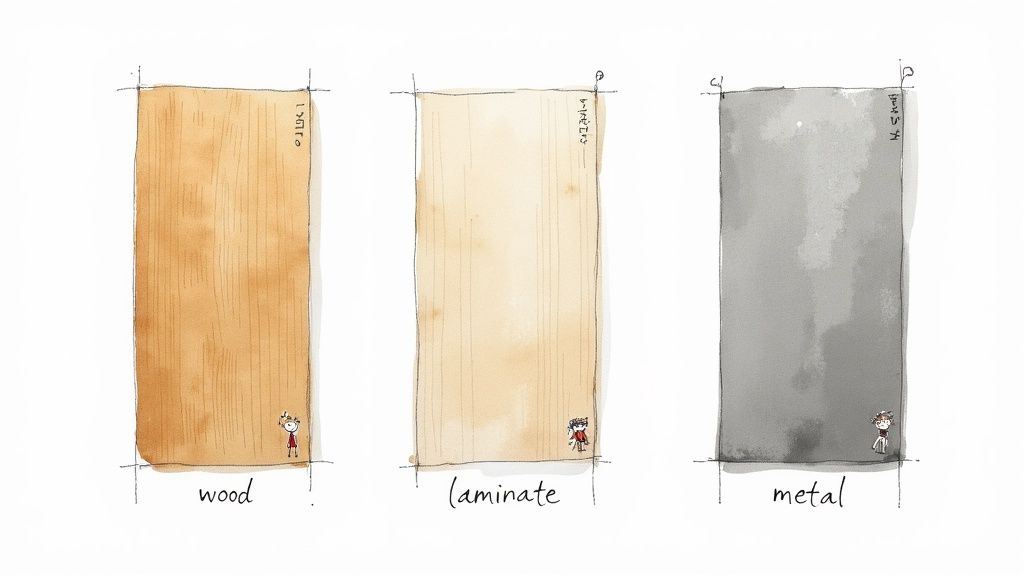
Here's where the magic really happens. The materials and finishes you choose will give your modular wall unit its soul, transforming it from a simple structure into a piece that truly reflects your personal style. Your task is to define the texture, color, and mood of your space.
To make the right choice, you need to balance the look you love with the practicalities of your lifestyle. The right finish must capture your vision while handling the realities of everyday use. Let’s explore the most popular options so you can select the best one for your home.
The Warmth and Character of Wood
There's a reason wood is a timeless choice—it brings an organic, grounding presence to any room. From the deep tones of walnut to the light feel of oak, wood introduces natural warmth and sophistication. Whether you choose solid wood or a high-quality veneer, the unique grain means your piece will be one-of-a-kind.
When you're looking at wood, you'll find a couple of main paths:
- Solid Wood: This is the real deal. Incredibly durable and beautiful, solid wood can last for generations. Choose it for unmatched authenticity and the ability to refinish it down the road, but be prepared for a more significant investment.
- Wood Veneers: Imagine a very thin slice of real wood bonded to a stable core like MDF. Select veneers for the genuine look of wood at a more approachable price. They are also often more resistant to warping, making them a smart and stylish choice.
If you're curious about the unique properties of different woods, you'll find great info in our guide on solid acacia wood, which gets into its incredible durability and striking grain patterns.
The Sleek Versatility of Modern Finishes
If your style leans more contemporary, minimalist, or industrial, modern finishes open up a new world. These materials are all about clean lines, uniform color, and a sleek profile.
Laminates and lacquers are fantastic for achieving that crisp, polished look. They come in an endless array of colors—from quiet neutrals to statement-making brights. Your actionable step here is to choose the sheen that fits your vibe, whether it's matte, satin, or high-gloss.
The power of modern finishes is in their precision. They let you create a seamless, intentional look that’s perfect for a clean and uncluttered space.
You'll also see metals like steel or aluminum, often used for uprights and brackets. For an industrial edge, leave these exposed. Alternatively, have them powder-coated in any color to either blend in or create a bold contrast. You can find more insights into material selection for luxury home design to see how these choices play out in high-end interiors.
For the most captivating design, try mixing materials. Picture warm wood shelves held by slim black metal supports, or high-gloss white cabinets paired with matte black handles. Combine different textures and finishes to create a dynamic, visually interesting wall unit modular system that feels completely you.
Comparing Modular Wall Unit Materials
To help you decide, here’s a quick comparison of the materials we’ve just discussed. Use this table to weigh the trade-offs.
| Material | Aesthetic & Feel | Durability | Maintenance Level | Relative Cost |
|---|---|---|---|---|
| Solid Wood | Warm, timeless, natural, unique grain | Very High | Medium | $$$$ |
| Wood Veneer | Looks like real wood, consistent finish | High | Low | $$$ |
| Laminate | Sleek, modern, uniform color | Very High | Very Low | $$ |
| Lacquer | High-gloss or matte, premium look | Medium | Medium-High | $$$ |
| Metal | Industrial, modern, structural | Very High | Low | $$ |
Ultimately, there’s no single "best" material—only the one that’s best for your home, your lifestyle, and your story.
Mastering the Art of Configuration and Design
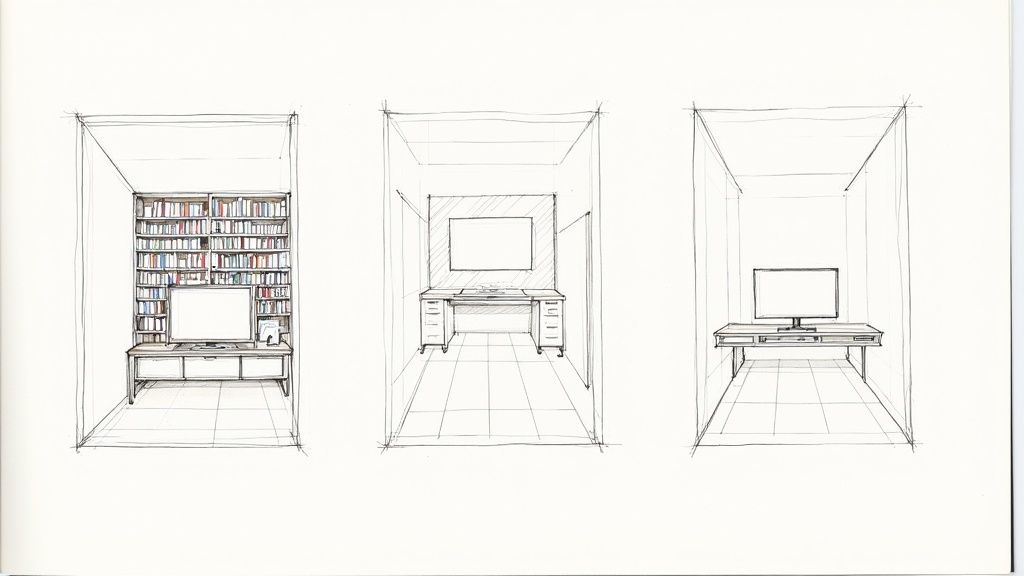
This is where the real fun begins. Designing your wall unit modular system is more than just picking parts; it’s an act of self-expression. It’s your chance to turn a vision into something tangible, beautiful, and functional. Take on the role of the designer to build a composition that is uniquely you.
Before you jump into picking modules, pause and assess your needs. Don’t just think "I need more storage." Go deeper. First, list exactly what you are storing. Next, decide what treasures deserve to be on display. Finally, determine if you need to integrate a TV, hide speakers, or create a discreet charging station. Getting these answers down first gives you the blueprint for everything that follows.
Finding Your Design Archetype
While your final creation will be one-of-a-kind, you can use classic archetypes as creative starting points. Each one brings a different energy and purpose to your wall.
-
The Symmetrical Library: To create a sense of order, choose a central anchor—like a media console or fireplace—flanked by identical columns of shelving and cabinetry. This powerful look delivers a balanced, intentional statement.
-
The Asymmetrical Hub: For a more dynamic feel, play with different heights, depths, and module types. Combine a cluster of closed cabinets on one side with open, floating shelves on the other to create a composition that feels alive and informal.
-
The Minimalist Floating Setup: To make a room feel larger, choose a wall-mounted system. By lifting every component off the ground, floating shelves and cabinets create an airy, spacious feel. This style celebrates negative space and makes the wall an integral part of the design.
It's no surprise that people are embracing this kind of adaptability. The global market for modular wall systems was valued at $10.5 billion in 2023 and is expected to nearly double to $20.8 billion by 2032. This incredible growth is all about our collective desire for spaces that can change and grow with us. You can see the full breakdown by reading the full market report on DataIntelo.
Principles of a Beautiful Composition
Once you have a general direction, refine your design with a few guiding principles. Applying these tips will take your configuration from simply practical to truly breathtaking.
The art of modular design lies in the balance between what you show and what you hide. It's the thoughtful interplay between open shelving and closed storage that creates visual rhythm and personality.
To create a stunning design, aim for harmony. Mix open shelves with closed cabinets to add visual texture and depth. Don't be afraid of negative space—leave empty areas around your modules to let the design breathe and prevent it from feeling cluttered. For more ideas on crafting a beautiful display, take a look at our guide to styling a contemporary shelf unit.
In the end, your goal is to build a system that tells your story. Let your personality be the guide, whether that leads you to a perfectly organized library or a vibrant, eclectic mix of art and cherished objects. This is your canvas—go create something that inspires you every single day.
Your Blueprint for a Flawless Installation
A brilliant design is only half the story; a perfect execution brings it to life. This is the moment your wall unit modular system becomes a physical reality. Getting the installation right ensures the safety and longevity of your investment, turning a collection of parts into a seamless architectural feature.
Before a single box is opened, you must measure your space with absolute precision. Don't just take one width and height measurement. Grab a quality tape measure and check dimensions at several points—top, middle, and bottom, as walls are rarely perfectly straight. Remember to map out the location of every outlet, light switch, and thermostat your unit might cover or need to work around.
DIY or Pro? Making the Call
With your measurements in hand, you’ve reached a fork in the road: DIY project or professional installation? The right choice depends on your comfort level, the system's complexity, and your available time.
Going the DIY route can be incredibly rewarding. However, it requires the right tools and patience.
Make sure you have these on hand before you start:
- A reliable stud finder to locate the strongest anchor points in your wall. This is non-negotiable.
- A good level (a laser level is a game-changer) to guarantee every shelf and cabinet is perfectly aligned.
- A power drill with the correct bits for your hardware and wall type.
- An extra pair of hands. Lifting and holding large components is a two-person job.
Hiring a professional installer, on the other hand, is buying peace of mind. These experts have seen it all—uneven walls, quirky floors, you name it. They come equipped with specialized tools and work with an efficiency that’s hard to match. This same focus on speed and precision is why the broader construction industry is embracing modular methods. In fact, the modular construction market is projected to hit $162.42 billion by 2030, largely because it can slash project timelines by up to 50%. You can explore these modular efficiency findings on Grand View Research to see how this trend is reshaping the industry.
Anchoring Your System for Good
The final, and most critical, step is to securely anchor your unit to the wall. The hardware you use is everything, and you must choose it based on your specific wall type.
The entire integrity of your installation rests on that connection between the wall and the unit. Using the wrong anchor is like building a house on a shaky foundation—it compromises the whole structure.
If you have drywall, you must anchor directly into the wooden or metal studs for maximum support. If a stud isn't exactly where you need it, use heavy-duty toggle bolts or specialized drywall anchors. For solid brick or concrete walls, use masonry anchors and a hammer drill to create pilot holes.
Always follow the manufacturer’s instructions, and never underestimate the final weight of the unit once it’s filled with your books, decor, and electronics. Taking these steps ensures your beautiful new wall unit modular system is as safe and solid as it is stunning.
Bringing Your Vision to Life with Griseo Interior
Standard modular systems offer plenty of flexibility, but a truly inspiring space is born when that flexibility meets real artistry. At Griseo Interior, we elevate the whole idea of a wall unit modular system, turning it from a piece of furniture into a bespoke architectural element that feels like it was always meant to be part of your home.
Our philosophy is simple, and it's rooted in a made-to-order Italian approach: precision engineering meets timeless craftsmanship.
We don't believe your vision should be boxed in by standard sizes. Every room has its own character and potential. That’s why our process starts with your specific dimensions. This allows us to create a unit that fits your room to the millimeter, transforming awkward nooks or uneven walls into stunning, intentional features.
The Art of Made-to-Order Italian Design
Think of our approach as a story of thoughtful creation. By blending artisanal heritage with modern technology, we ensure every component is crafted with purpose. This isn't mass production; it's a personal journey we take with you to build something that truly speaks to your lifestyle and aesthetic.
At Griseo Interior, we merge the soul of Italian craftsmanship with the precision of modern design. The result is a modular system that is not just built for your space, but born from it.
This commitment extends to our materials. We've curated a selection of high-quality, sustainable options, giving you the freedom to choose finishes that align with both your values and your vision. This is a real, tangible benefit—you’re investing in a piece that is not only beautiful but is built to last with a deep respect for the environment.
A Flawless Fit for Your Home
Ultimately, the true magic of a made-to-order system lies in its seamless integration. Where others see a challenging wall, we see an opportunity for a custom solution. Our process is designed to ensure that your final wall unit modular design feels like a natural extension of your home’s architecture.
Here's how our philosophy benefits you:
- Unmatched Customization: We don't just adapt—we create pieces to your exact specifications, guaranteeing a flawless fit every time.
- Timeless Craftsmanship: Every unit is a testament to the rich heritage of Italian design and an obsessive attention to detail.
- Sustainable Materials: You get to choose from a range of beautiful, high-quality, and responsibly sourced finishes.
The end result is a system that does more than just organize your life. It elevates it, bringing a sense of harmony and bespoke elegance that is unmistakably, completely yours.
Answering Your Modular Wall Unit Questions
It's completely normal to have a few lingering questions, even when you feel like you've got a solid plan. Thinking through the practical side of things is what turns a good idea into a great, long-lasting investment for your home. Let's tackle some of the most common ones.
How Much Weight Can a Modular Wall Unit Hold?
This is a big one, and the honest answer is: it depends. The final weight capacity comes down to the system's design, the materials used, and—most importantly—how it’s anchored to your wall.
As a general rule, steel uprights drilled directly into wall studs can often support 50-75 lbs per shelf. Your actionable step is to always treat the manufacturer's official specs as your guide. If you're planning to display a heavy book collection or hefty ceramics, consider systems that are partially floor-supported. For anything heavy, professional installation is the best way to guarantee you’re using the right anchors for your wall type, ensuring total safety and peace of mind.
Can I Reconfigure My System Later?
Yes, absolutely! That’s the whole magic of modular design. Adaptability is built right into their DNA.
Most quality systems are designed so you can easily add more shelves, cabinets, or desks down the road. To ensure future compatibility, a smart move is to stick with an established brand so you can find matching parts years from now.
Are Modular Wall Units Good for Small Spaces?
They aren't just good for small spaces; they're often the perfect solution. By design, they draw the eye upward and make use of vertical space, freeing up valuable floor area.
The beauty of a modular wall unit is that you can create a configuration that fits perfectly into an awkward nook or a narrow wall, giving you maximum storage without the visual weight of a bulky, traditional piece of furniture. A wall-hung or "floating" system takes this even further, creating a wonderful sense of openness and light.
Ready to design a space that truly grows with you? Explore the bespoke, made-to-order possibilities with Griseo Interior and bring authentic Italian craftsmanship into your home. Discover your perfect fit.