

3D Printing vs Traditional Manufacturing: How to Choose the Right Method
Choosing between 3D printing and traditional manufacturing comes down to a simple, practical question: do you need to build an object from scratch, layer by delicate layer, or carve it from a solid block? Your answer hinges on a clear-eyed assessment of your project's goals. This guide provides the actionable advice you need to decide whether the freedom of custom design or the power of mass production is the right strategic move for you.
The New Era of Creation: From Digital Vision to Tangible Reality
Turning a digital idea into a physical object is faster than ever, but choosing the right manufacturing path is a critical strategic decision. It dictates your product's cost, speed to market, and design possibilities.
One approach offers unparalleled creative freedom for on-demand creation. The other provides proven efficiency at scale. To make the right call, you need to understand the practical differences. A good starting point is to see where additive manufacturing fits into the broader landscape of top manufacturing technologies shaping 2025. This guide will walk you through the decision-making process, helping you choose the best method for your specific project.
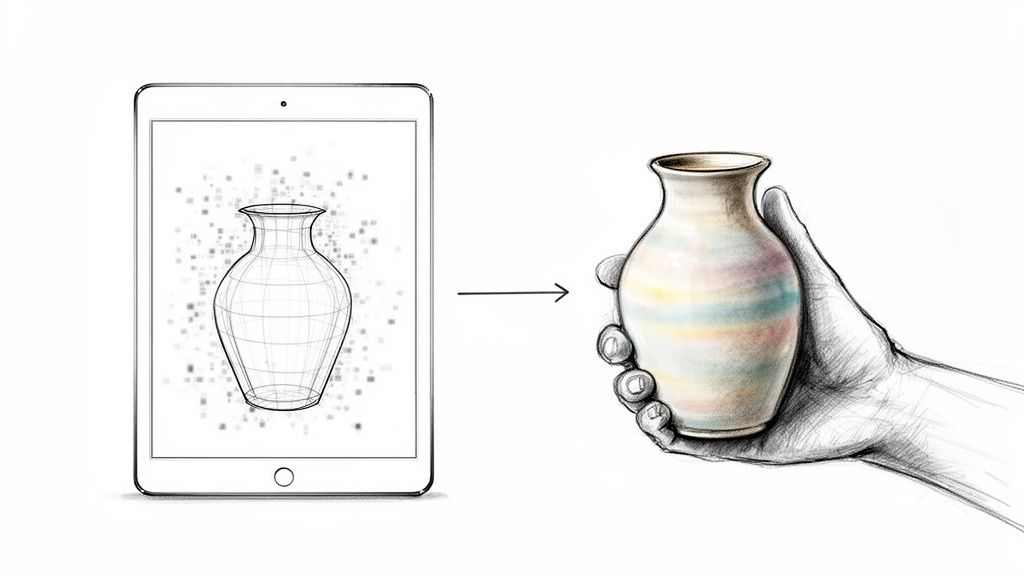
Defining the Two Philosophies
To choose effectively, you must understand the two core manufacturing philosophies. Each one impacts your project's cost, speed, creative potential, and environmental footprint.
-
Actionable Tip for Additive Manufacturing (3D Printing): Use this method when you need to build a complex object from a digital file by adding material one layer at a time. It's the ideal choice for creating prototypes or custom parts with minimal waste.
-
Actionable Tip for Traditional Manufacturing: Opt for these methods—subtractive (like CNC milling) or formative (like injection molding)—when you are mass-producing a standardized design. Subtractive is best for carving from a solid block, while formative is for shaping material in a mold.
Here’s a practical breakdown to guide your choice:
| Feature | 3D Printing (Additive) | Traditional Manufacturing |
|---|---|---|
| Process | Builds objects layer-by-layer from a digital file | Carves from a block or shapes material in a mold |
| Best For | Prototypes, custom parts, complex geometries | Mass production, simpler and standardized parts |
| Waste | Minimal, since it only uses the material needed | Can be significant, especially in subtractive methods |
| Initial Cost | Low, with no need for expensive tooling or molds | High, often requiring costly molds and setup |
The 3D printing market reflects its growing utility, valued at USD 15.39 billion in 2024 and projected to hit USD 35.79 billion by 2030. This growth highlights its agility and customization capabilities, which you should leverage for projects that don't require the high-volume output of traditional methods.
Comparing the Core Production Philosophies
To make an informed decision between 3D printing and traditional manufacturing, you must analyze the practical trade-offs. This isn't just a technical choice—it's a project management decision that will define your product's entire lifecycle.
Focus on the five critical factors that will directly impact your project's success.
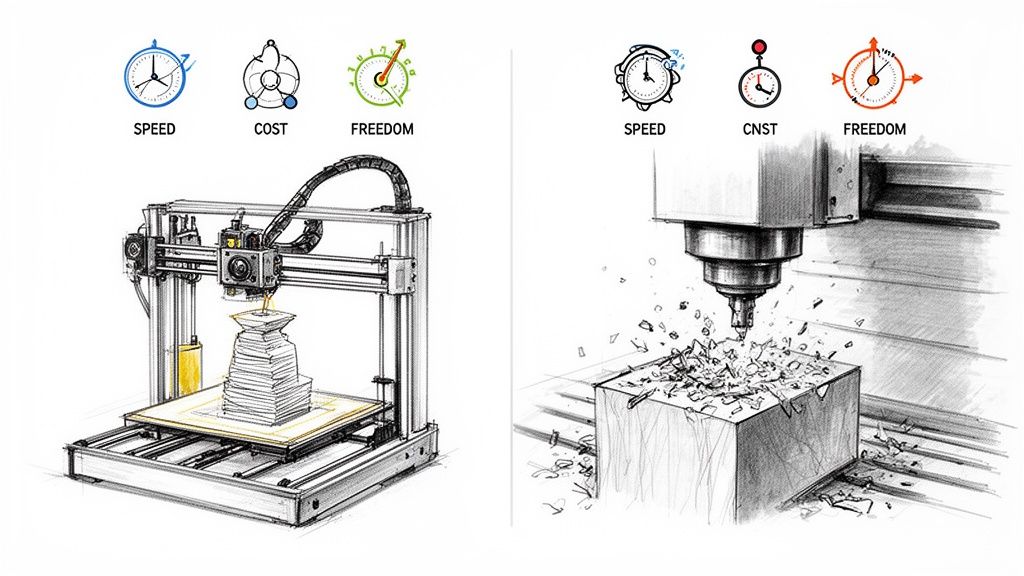
Assess your project based on speed, budget, design complexity, material requirements, and scalability. One path offers agility for unique items; the other provides efficiency for mass production. Let’s determine which one aligns with your needs.
Speed to Market: From Concept to Customer
If your primary goal is rapid development, the choice is clear. Traditional methods require significant upfront time for tooling and setup, often taking weeks or months before the first part is produced. Creating a mold for injection molding, for example, is a major project in itself.
Actionable Advice: Use 3D printing when speed is your top priority. A designer can finalize a CAD file in the morning and hold a physical prototype by evening. This rapid iteration is crucial for testing and refining products quickly, a key advantage for on-demand businesses like Griseo Interior. This speed is one of the core benefits of additive manufacturing.
Cost Structures: Upfront vs. Per-Part
Your budget structure will dictate your manufacturing choice. Traditional manufacturing demands high initial investment but delivers a very low cost per unit at scale.
- Traditional Manufacturing: Choose this if you have the capital for tooling and molds and need to produce thousands of identical items, like a plastic water bottle. The high upfront cost is offset by efficiency in mass production.
- 3D Printing: Select this method if you have a limited upfront budget. With virtually zero setup cost, the price per part remains constant, making it ideal for prototypes, custom orders, or small production runs.
Practical Takeaway: For a new brand or independent creator, 3D printing is a powerful tool. It removes the financial barrier to entry, allowing you to validate ideas and produce high-quality, bespoke items without the risk of a large capital investment.
Design Freedom and Complexity
Your design's complexity is a major deciding factor. Traditional manufacturing is constrained by its tools; drills, molds, and cutters limit the feasibility of complex internal geometries or organic shapes.
Actionable Advice: Leverage 3D printing when your design is complex. Since it builds objects layer by layer, complexity is essentially free. An ornate, hollow vase with an intricate internal lattice is no more difficult to print than a simple solid cube. This lets you design for function and aesthetics without being constrained by manufacturing limitations.
Material Possibilities and Production Scalability
While traditional manufacturing offers a vast, established library of materials, 3D printing is rapidly expanding its palette to include advanced polymers, biocompatible resins, and metals, though material costs can be higher.
When scaling production, traditional methods like injection molding are unmatched for speed, producing parts in seconds. 3D printing is slower per part, making it less suitable for mass production. However, for a made-to-order model like Griseo Interior's, this is an advantage, enabling intentional, waste-free production.
Here’s how to weigh these factors for your project.
At-a-Glance Comparison: 3D Printing vs. Traditional Manufacturing
Use this table as a quick reference tool to select the best approach for your specific needs.
| Factor | 3D Printing (Additive) | Traditional Manufacturing (Subtractive/Formative) |
|---|---|---|
| Speed to Market | Extremely Fast: Hours or days for prototypes and small batches. | Slow: Weeks or months for tooling and setup. |
| Cost Structure | Low Upfront Cost: Consistent per-part price, ideal for low volumes. | High Upfront Cost: Low per-part price at high volumes. |
| Design Freedom | Nearly Limitless: Intricate, complex geometries are easy to produce. | Constrained: Limited by tooling, molds, and machine capabilities. |
| Scalability | Excellent for Customization: Best for low to medium volumes and on-demand production. | Built for Mass Production: Unbeatable efficiency for high-volume runs. |
| Best For | Prototyping, bespoke items, complex parts like a Griseo Interior vase. | Mass-produced goods like automotive parts or consumer electronics. |
Your choice depends on your project's core requirements. One offers speed and flexibility for unique items, while the other provides efficiency for large-scale production. The key is to match the method to the mission.
Analyzing the True Environmental Impact
Your choice of manufacturing method has a direct environmental consequence. To make a responsible decision, you need to understand the material waste, supply chain implications, and energy usage of each process.
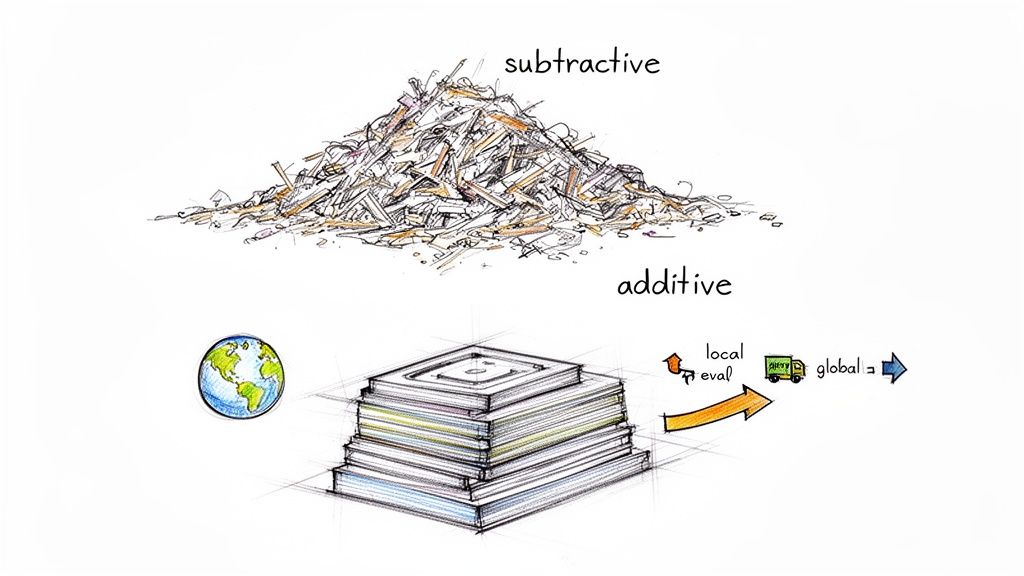
The primary difference is waste. Traditional subtractive methods, like CNC milling, start with a solid block and generate significant scrap by carving material away.
The Efficiency of Additive Creation
Additive manufacturing offers a more sustainable alternative. By building objects layer by layer, it uses only the material needed, virtually eliminating waste.
Actionable Data: Traditional manufacturing can result in up to 90% material loss. In contrast, a 2023 study showed that 22% of 3D printing users adopted it specifically to reduce waste. Projections indicate that this material efficiency could help prevent up to 525.5 million metric tons of CO2 emissions by 2025. If sustainability is a key project metric, 3D printing is a strong choice.
Rethinking the Supply Chain
Traditional manufacturing relies on centralized factories and long, carbon-intensive supply chains.
Actionable Advice: Use 3D printing to enable localized, on-demand production. Instead of shipping a finished product globally, you can send a digital file to a printer near your customer. This drastically reduces transportation emissions and packaging waste.
Practical Takeaway: Adopt an on-demand model to eliminate the waste of overproduction and the energy costs of warehousing unsold goods. This approach, central to Griseo Interior's philosophy, ensures every item is created with purpose.
This strategy is foundational to our work. Our made-to-order model, powered by 3D printing, ensures we only produce what is desired. Learn more about how to implement this in our guide to sustainable manufacturing practices.
Energy Consumption and Material Lifecycles
While 3D printers consume energy, a holistic view is necessary. For custom and small-batch production, the energy saved by avoiding the production, transport, and processing of raw materials for molds often makes additive methods more efficient overall.
Furthermore, the 3D printing industry is increasingly using recycled and biodegradable materials like rPET and PLA. When planning your project, investigate these sustainable material options to create a circular lifecycle for your product.
Deciding Which Method Fits Your Project
You have the information. Now, let's apply it. The right choice depends entirely on your project's specific goals, scale, and design. Use these real-world scenarios to build your decision-making framework.
Scenario 1: Prototyping a Groundbreaking Product
You have an innovative idea for an ergonomic tool and need to iterate on the design based on physical testing and feedback.
Recommendation: Choose 3D Printing.
Action Plan: Use 3D printing to rapidly produce physical models from your digital files. This allows for a fast test-tweak-retest cycle without incurring the high costs and long lead times of traditional tooling. You can have a new version in hand in hours, not weeks.
Scenario 2: Creating a One-of-a-Kind Custom Piece
A client commissions a unique, lightweight sculptural centerpiece with a complex, hollow interior. It will be a one-off creation.
Recommendation: Choose 3D Printing.
Action Plan: This is a perfect use case for additive manufacturing. Traditional methods would be prohibitively expensive or technically impossible for a single, geometrically complex piece. Use 3D printing to achieve the design's intricate details without compromise.
This on-demand approach is the core of our creative process at Griseo Interior. It ensures every piece is made with intention for a specific person, eliminating waste and celebrating unique design.
This decision-making process is common in creative industries. For example, brands must evaluate tools based on project needs when choosing between AI vs. Traditional Photography: Making the Right Choice. The key is to match the tool to the task.
Scenario 3: Mass-Producing 10,000 Standard Units
Your company requires a large volume of simple, identical plastic components for a new electronic device with a finalized design. The primary goal is the lowest possible cost per unit.
Recommendation: Choose Traditional Manufacturing.
Action Plan: Opt for injection molding. Although the initial mold cost is high, the per-part cost becomes extremely low at high volumes. This method can produce parts in seconds, offering an economy of scale that 3D printing cannot match for runs of 10,000 units or more.
To maximize efficiency in high-volume runs, incorporate strategies from the benefits of lean manufacturing.
Scenario 4: Crafting an Intricate Architectural Model
An architecture firm needs a highly detailed scale model of a new building, featuring complex facade latticework and precise internal structures.
Recommendation: Choose 3D Printing.
Action Plan: Use a high-resolution 3D printer to translate the sophisticated CAD file into a physical model. This is the only way to accurately reproduce the fine, complex geometries required, achieving a level of detail that traditional methods cannot match.
Use these scenarios as a practical guide. Evaluate your project's needs against them to confidently select the right tool to execute your vision.
Where Modern Tech Meets Timeless Craftsmanship
The most innovative solution often isn't choosing one method over another but combining them. The best results can come from integrating the precision of technology with the irreplaceable touch of human craftsmanship. This hybrid approach creates products that are both technically flawless and artistically meaningful.
At Griseo Interior, we don't see the 3D printing vs. traditional manufacturing debate as a conflict but as an opportunity. This approach allows us to create objects that are both precise and personal, capturing the best of both worlds.
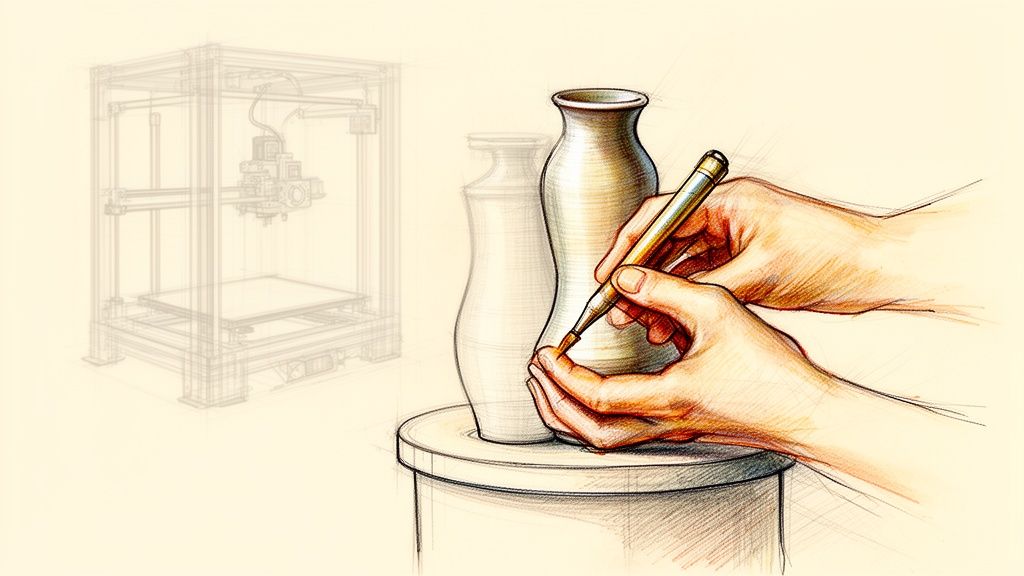
A hybrid model proves that innovation and tradition can coexist to produce superior objects that honor both the future and the past.
The Griseo Interior Story: A Hybrid Approach
Our process starts with a digital design. We use 3D printing for what it does best: transforming complex designs into physical forms with exceptional accuracy and minimal waste. This technology is the engine of our made-to-order model, ensuring we only produce what is truly wanted.
Here is our practical, two-stage workflow for the 'Serenitatem' vase:
-
Digital Conception and Additive Creation: The process begins with a detailed 3D model. We use advanced additive manufacturing to build the vase's form layer by layer from sustainable materials. This creates a perfect geometric foundation.
-
Artisanal Hand-Finishing: The printed form is then given to skilled Italian artisans. Technology's role ends, and tradition begins. Each vase is meticulously sanded, smoothed, and finished by hand, imparting a unique character and tactile quality that a machine cannot replicate.
This two-step process is our actionable solution to the modern production challenge. We leverage technology for efficiency and sustainability, but we rely on human hands to give each object its soul.
By combining the adaptability of 3D printing with the irreplaceable touch of artisanal finishing, we honor the legacy of 'Made in Italy' design while advancing modern manufacturing.
Why a Hybrid Model Works
This integrated method offers practical advantages that neither process can achieve alone.
- Bespoke Production at Scale: It enables the creation of customized pieces without the prohibitive costs of traditional one-off manufacturing.
- Unmatched Quality: 3D printing ensures design accuracy, while hand-finishing provides a superior surface feel that is otherwise unattainable.
- Sustainable by Design: The on-demand nature of 3D printing eliminates overproduction, and the focus on handcrafted quality ensures each piece is built to last.
The Griseo Interior model is a practical blueprint for the future of conscious creation. It demonstrates that weaving old and new methods together results in something truly extraordinary.
Putting It All Together: Making the Right Call
You've explored the core concepts, practical applications, and even a hybrid model. Now, it's time to use this knowledge to make a confident decision for your next project.
The "3D printing vs. traditional manufacturing" choice isn't about finding a single winner. It's about a clear-eyed assessment of your project's specific needs. By asking the right questions, you can determine the optimal path forward.
Your Project Decision Checklist
Use this checklist as a practical tool. Before you commit to a production method, answer these four questions to guide your decision.
-
How Many Are You Making?
- Just a few (1-500 units): For prototyping, custom orders, or small runs, choose 3D printing. Its lack of setup costs makes it the most cost-effective option.
- A whole lot (5,000+ units): For mass production of identical items, choose traditional manufacturing. The high initial tooling cost is justified by an extremely low per-part cost at scale.
-
How Wild is Your Design?
- Highly Complex: If your design features intricate internal structures, organic curves, or complex geometries, 3D printing is your only practical option. Complexity does not increase cost with this method.
- Simple and Solid: For straightforward designs that are easily milled, molded, or stamped, traditional methods offer proven reliability and efficiency.
Your goal is not to declare one method superior but to select the right tool for the job. Choose the one that will bring your vision to life most effectively.
-
What’s Your Upfront Budget?
- Lean and Mean: To get started without significant capital investment, choose 3D printing. You avoid the high cost of molds and tooling, lowering the barrier to entry.
- Ready to Invest: If you have the capital for a large upfront investment to achieve long-term savings at scale, traditional manufacturing is the correct strategic choice.
-
How Fast Do You Need It?
- Yesterday: For rapid prototyping and fast turnaround, 3D printing is unmatched. Go from a digital file to a physical part in hours or days.
- Time is on Your Side: If you have weeks or months for setup before a large production run, the longer lead time of traditional manufacturing is an acceptable trade-off for its efficiency at scale.
Use this checklist to make an informed, confident decision. Trust the data, respect your design, and choose the path that best aligns with your project goals.
Got Questions? We’ve Got Answers.
When deciding between 3D printing and traditional manufacturing, a few key questions often arise. Here are direct answers to help you finalize your project plan.
Is 3D Printing Really Cheaper for Small Batches?
Yes, absolutely. For prototypes, custom pieces, or small production runs, 3D printing is almost always the more cost-effective choice.
This is because it eliminates the need for tooling (molds or custom setups), which is the most expensive part of traditional manufacturing. The cost to produce the first part is the same as the cost to produce the hundredth, giving you predictable expenses without a large upfront investment.
Can a 3D Printed Part Ever Be as Strong as a Traditionally Made One?
The answer depends on the material and the specific application. While methods like injection molding produce exceptionally tough parts, modern 3D printing materials like carbon fiber composites and engineering-grade polymers offer impressive durability.
The key difference is anisotropy: 3D printed parts are built in layers and can be weaker along these layer lines. Actionable Tip: To maximize strength, orient your part during printing so that the primary operational forces run parallel to the layers, not against them. For most applications, a well-designed 3D printed part is more than strong enough.
How Steep is the Learning Curve to Get Started?
Entry into 3D printing is easier than ever. With user-friendly desktop printers and intuitive software, a beginner can produce high-quality prints within days.
In contrast, mastering a traditional process like CNC milling or injection molding requires a significant time investment, often involving years of hands-on training to operate complex machinery and understand material behaviors.
What’s Next for These Two Worlds of Manufacturing?
Both technologies have a robust future. Traditional manufacturing will remain dominant for high-volume, standardized production due to its unbeatable cost-efficiency at scale.
Simultaneously, 3D printing will continue to advance on-demand production, personalization, and sustainable manufacturing. The most exciting developments will come from a hybrid model, where technology provides the precision foundation and a skilled artisan adds the final, human touch. This philosophy is at the heart of everything we create.
At Griseo Interior, we live at that beautiful intersection of modern precision and timeless Italian craftsmanship. We create pieces that do more than fill a space; they tell a story. Discover our collection of made-to-order decor and bring conscious, beautiful design into your home.
Explore our designs at https://griseointerior.com.